
 EN
EN
Quick Links


93 Shore A

good

Very good

Outstanding
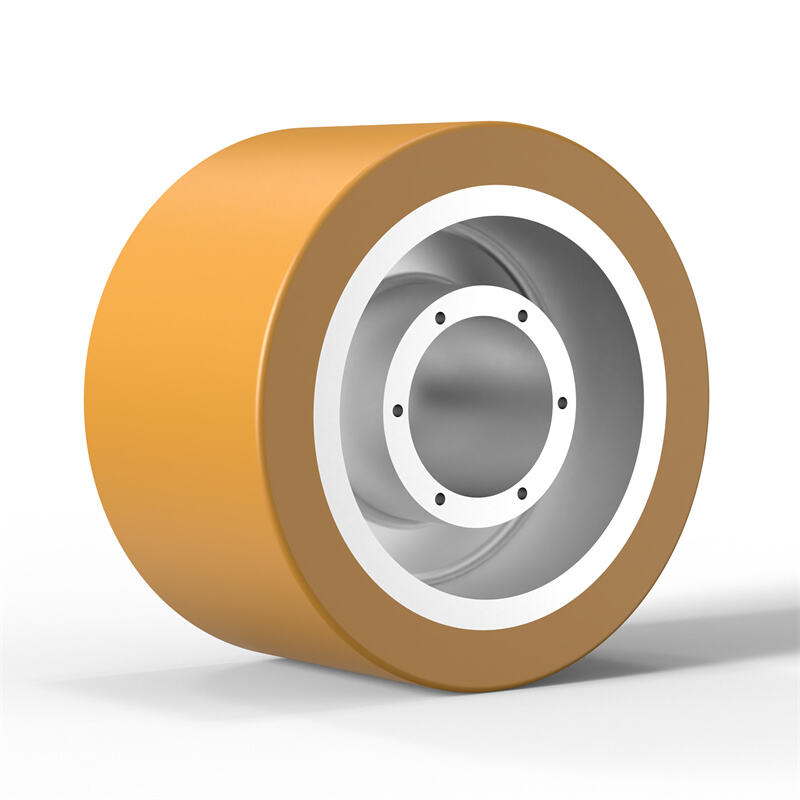
Tread: High-quality polyurethane elastomer cast through chemical reaction, with a hardness of 93±3 Shore A. It features low walking noise, low rolling resistance, ground protection, excellent wear resistance, high cut and tear resistance, and is non-marking, non-staining, and has excellent adhesion to the wheel hub.
Wheel Hub: Available in 45# steel, cast iron, die-cast aluminum alloy, stainless steel, and other metal materials depending on the working conditions; surface treatments include painting, phosphating, galvanizing, and Dacromet coating.
Other Characteristics: Resistant to various corrosive substances; operating temperature: -30°C to +70°C, short-term up to +90°C; load capacity decreases above +40°C.
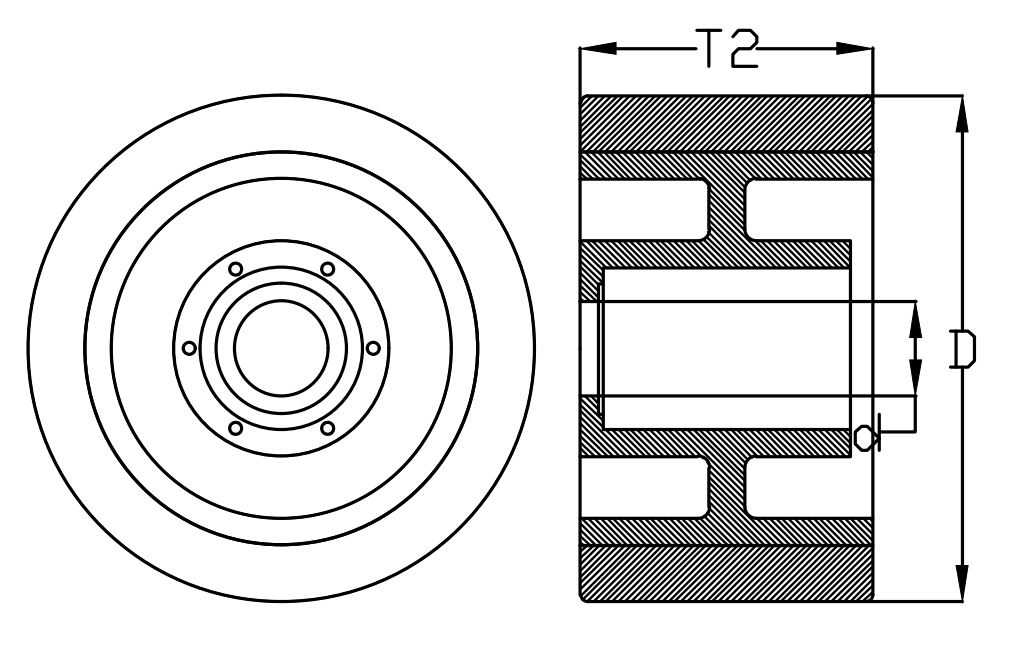
| Single Wheel | Wheel Diameter (D)mm |
Wheel Width (T2)mm |
Load Capacity at 4km/h(kg) | Load Capacity at 10km/h(kg) | Bearing Type | Bore Shaft Diameter | Hub Length |
|||||||||||
| VEG 250*50 | 100 | 40 | 400 | / | Customizable | |||||||||||||
| VEG 250*60 | 125 | 40 | 450 | / | Customizable | |||||||||||||
| VEG 300*45 | 150 | 40 | 650 | 300 | Customizable | |||||||||||||
| VEG 300*80 | 165 | 40 | 750 | 350 | Customizable | |||||||||||||
| VEG 300*100 | 180 | 50 | 850 | 420 | Customizable | |||||||||||||
| VEG 360*75 | 200 | 50 | 900 | 450 | Customizable | |||||||||||||
| VEG 360*100 | 200 | 80 | 1400 | 700 | Customizable | |||||||||||||
| VEG 400*80 | 250 | 80 | 1800 | 900 | Customizable | |||||||||||||
| VEG 400*125 | 250 | 100 | 2200 | 1100 | Customizable | |||||||||||||
| VEG 500*100 | 300 | 100 | 2700 | 1350 | Customizable | |||||||||||||
| VEG 600*125 | 350 | 80 | 2200 | 1100 | Customizable | |||||||||||||
| VEG 600*200 | 400 | 100 | 3400 | 1700 | Customizable | |||||||||||||
| VEG 750*200 | 450 | 150 | 6500 | 3000 | Customizable | |||||||||||||
| Other sizes available upon inquiry | ||||||||||||||||||
Standard warranty is 12 months. For confirmed quality issues, we provide free replacement or full refund. Each shipment includes material test reports and dimensional inspection reports.
35 years in polyurethane wheel manufacturing, 52 patents, products exported to 40+ countries. We can provide ISO and ROHS certification documents upon request. OEM/ODM services available.
MOQ: Standard products 100 pcs; custom products — please consult.
Samples: Standard products 1-3 pcs (shipping at buyer's expense); custom products — please consult.
Sample lead time: 30 days.
T/T, L/C, PayPal. New clients: 30% deposit + 70% before shipment. Long-term clients: flexible payment terms available upon negotiation.
On-time delivery rate: 98%+. We notify you promptly in case of force majeure.
In-stock standard products: 3-7 working days
Standard products (to produce): 25-30 working days
Custom products (new mold): 30-40 working days
Bulk orders (≥1000 pcs): 45 working days
Choose polyurethane when: Load ≥ 500kg/wheel, high-frequency movement, oil/chemical exposure, high noise requirements, floor protection needed, long service life required.
Choose rubber when: Load < 200kg, occasional movement, pure indoor no-corrosion environment, cost priority, short-term use.
Still unsure? Ask yourself: (1) Load over 500kg? → Polyurethane. (2) Moving more than 8 hours/day? → Polyurethane. (3) Budget first? → Rubber.
Standard series: 50kg – 10 tons/wheel, maximum 15m/s. We recommend suitable specifications based on your working conditions.
Temperature: Standard: -20°C to +70°C; optional high-temp: +80°C; low-temp: -30°C
Chemical resistance: Oil, weak acids and alkalis; please consult for special chemicals
Outdoor use: UV-resistant coating available
Full customization available: outer diameter / width / hub length / bore diameter, load capacity, bearing brands (HRB, LYC, SKF, etc.), hardness (Shore A 55-95), color, special functions (high-temp resistant, oil resistant, anti-static)
Yes, but with trade-offs. Higher hardness = greater load capacity, but also means reduced shock absorption, increased noise levels, and poorer floor protection. The right hardness requires balancing: load + running speed + floor protection needs. Our engineers can recommend the optimal specification based on your actual working conditions.
Standard polyurethane is resistant to mineral oils, but ester-based oils (such as hydraulic oil) can cause erosion. For oily environments, we recommend oil-resistant formulations with enhanced bearing seals. For coolant environments, please confirm the fluid composition — we will recommend a suitable formulation based on fluid type, temperature, and concentration.
The more details you provide, the more accurate your quote will be:
1. Application (e.g., AGV drive wheel, conveyor idler, forklift wheel)
2. Load capacity (max weight per wheel in kg)
3. Running speed (m/s or rpm)
4. Wheel dimensions (OD × width × hub length × bore diameter)
5. Bearing requirements (brand preference or ask for recommendation)
6. Order quantity (monthly usage or one-time order)
7. Working environment (indoor/outdoor, temperature, oil/chemical exposure)
8. Customization needs (new mold or modify existing mold)
Formula: Required Load = Total Weight ÷ Number of Wheels × Duty Factor × Safety Factor (1.25)
Duty factors:
Indoor, flat floor: 1.2
Indoor with thresholds/cables: 1.5
Outdoor/uneven surface: 2.0
Example: Equipment weighing 3000kg, 4 wheels, indoor with thresholds
Choose polyurethane when: Load ≥ 500kg/wheel, high-frequency movement, oil/chemical exposure, high noise requirements, floor protection needed, long service life required.
Choose rubber when: Load < 200kg, occasional movement, pure indoor no-corrosion environment, cost priority, short-term use.
Still unsure? Ask yourself: (1) Load over 500kg? → Polyurethane. (2) Moving more than 8 hours/day? → Polyurethane. (3) Budget first? → Rubber.
Five main failure modes:
Delamination: Cause: overload, impact, poor bonding. Prevention: keep load ≤ 80% of rated capacity, avoid fast passage over obstacles.
Abnormal wear: Cause: overspeed, bearing failure, debris. Prevention: speed ≤ 15m/s, inspect bearings regularly.
Permanent set (flattening): Cause: sustained static load, wrong hardness. Prevention: static load ≤ 80% rated, use higher hardness for heavy static loads.
Low-temperature cracking: Cause: wrong formulation for cold environments. Prevention: below -20°C, use Shore A 55-65 formula.
Bearing failure: Cause: lubrication failure, contamination, overload. Prevention: regular
Reference service life (standard conditions):
Light load, low speed (<500kg, <3m/s): 3-5 years
Medium load (500-1500kg, 3-8m/s): 1.5-3 years
Heavy load, medium speed (1500-3000kg, 3-10m/s): 8-18 months
Heavy load, high speed (3000kg+, 8-15m/s): 4-12 months
Key lifespan factors: Load (40%) > Speed (25%) > Temperature (15%) > Chemicals (10%) > Impact (7%)
To extend lifespan: Keep load at 70-80% of rated capacity, speed at 60-80% of rated, avoid sustained static loading, inspect bearings regularly. Contact our engineers for sample testing to get accurate lifespan data for your specific conditions.
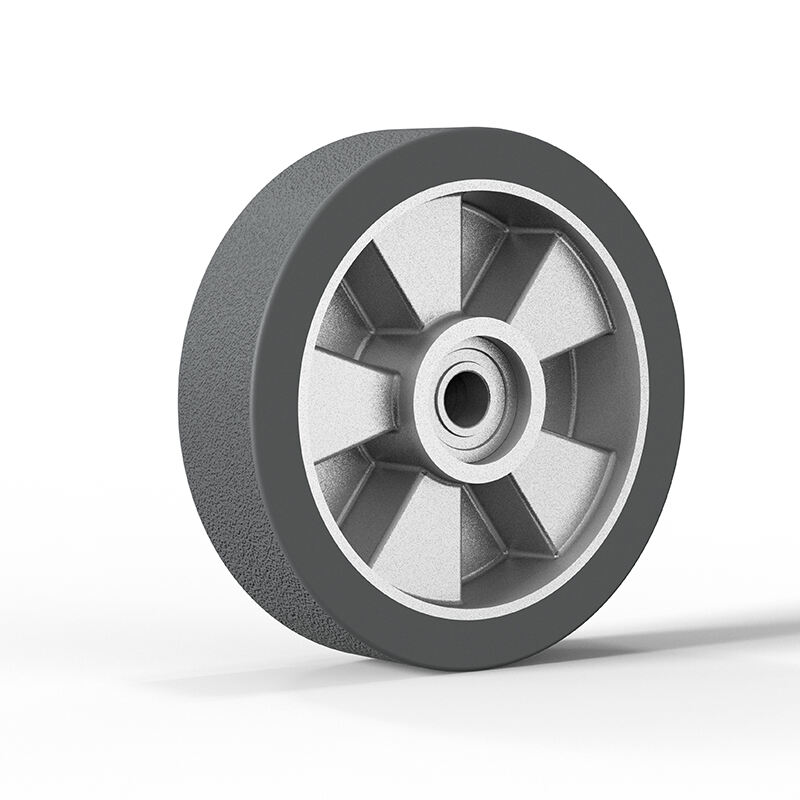
GSF01 Series-Aluminum Core PU Floor Scruuber Wheels
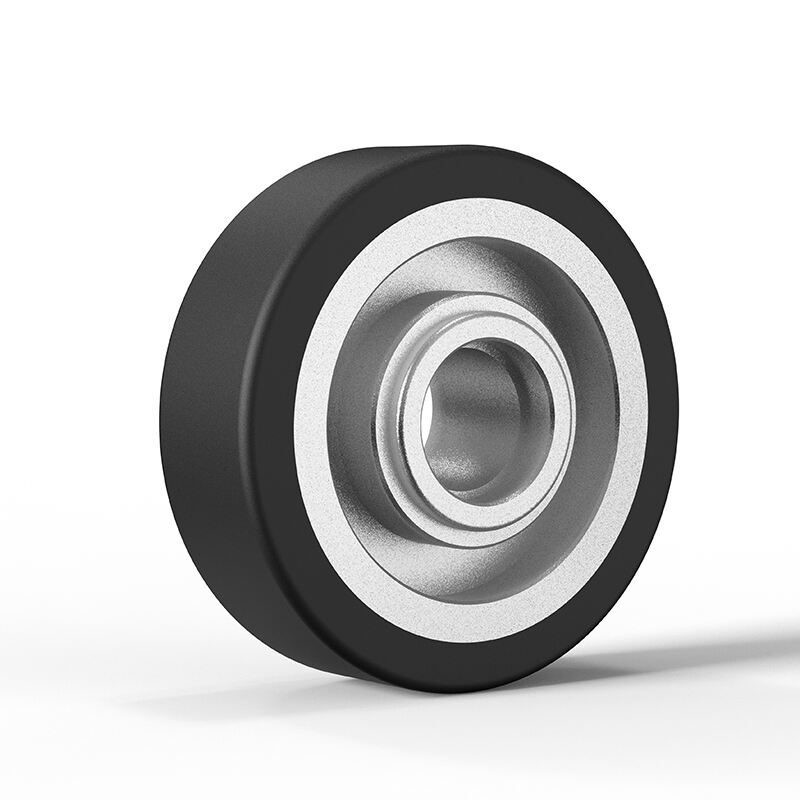
VSA Series-Polyurethane Driven Wheel
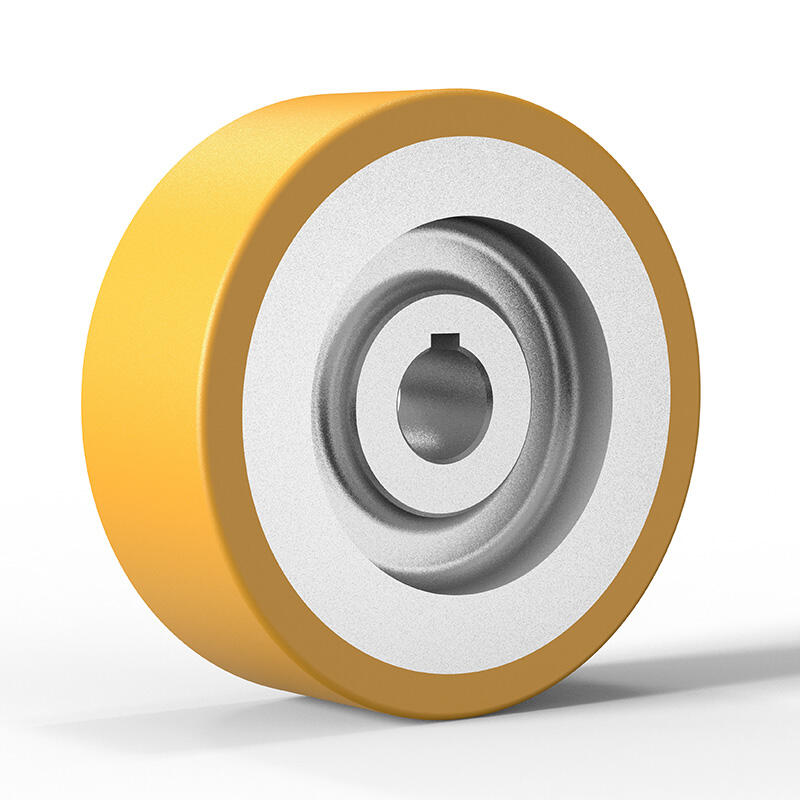
GEJB Series-Polyurethane Drive Wheel(Keyway)
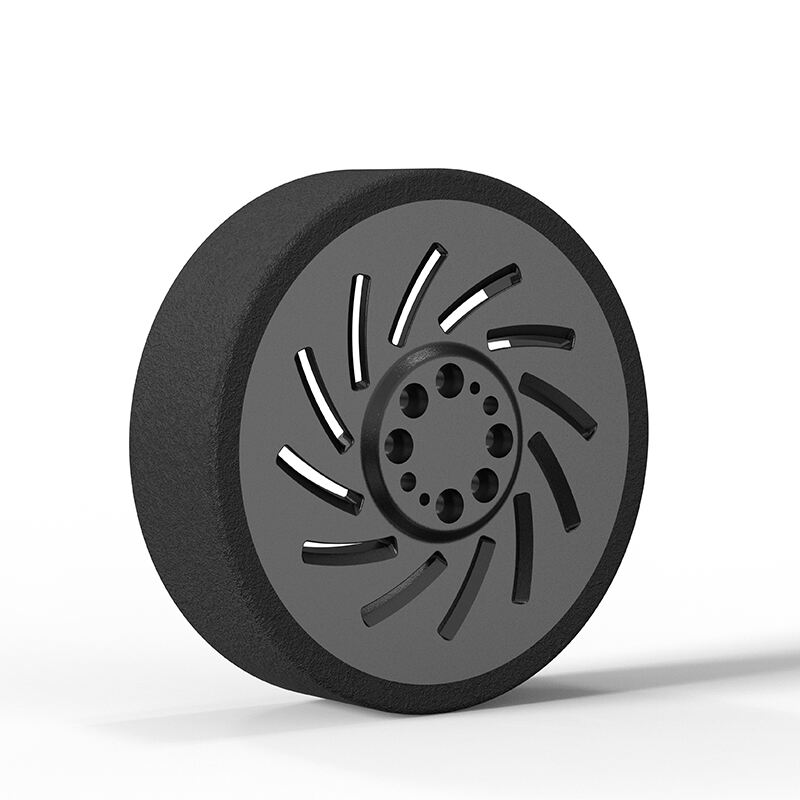
Customized Wheels-Vortex-Shaped Hole Mounting Wheel

