
 EN
EN
Quick Links
 1. Why Outdoor Equipment Is Outgrowing Pneumatic Tires
Think of a wheel as the feet of your machine. Outdoors, those feet face a long, punishing endurance race. Unlike the flat, dry, temperature-controlled floors of a workshop, outdoor work means gravel, mud, standing water, rough surfaces, sun exposure, and wide day-night temperature swings - each placing extra demands on the wheel. Pneumatic tires were once the common outdoor choice because of their good shock absorption and low rolling resistance, but real-world operation exposes a few unavoidable weaknesses.
On gravel sites, construction lots, and the edges of green spaces, sharp stones and metal fragments are the natural enemy of a pneumatic tire. A single puncture can leave a machine stranded in the field for hours, and outdoor sites are often far from repair stations where patching or changing a tire is time-consuming and difficult. For garden, sanitation, and logistics operations that depend on continuous equipment uptime, the cost of one puncture easily exceeds the price of the tire itself.
Pneumatic tires must be inspected and maintained at the correct pressure. Over-inflation reduces grip; under-inflation accelerates wear and can even become a safety hazard. On outdoor sites where many machines work at once, checking the pressure of every single unit is a real expense in itself. Worse, when a tire is running at the wrong pressure, it is often only discovered after the machine has already failed.
Heavy loads, high heat, and abnormal pressure can combine to trigger a blowout. In outdoor heavy-duty material handling - forklifts, transfer trucks - a blowout does not just interrupt work; it can endanger the operator and everyone nearby. This is the fundamental reason airless (non-pneumatic) solutions are spreading quickly across heavy outdoor duty: they eliminate leaks and blowouts by design.
When punctures, leaks, blowouts, and pressure maintenance all stack up against pneumatic tires, more and more outdoor equipment manufacturers are turning to non-pneumatic (airless) tires. A non-pneumatic tire is a wheel that does not rely on internal air pressure to support its load. It removes the maintenance and reliability pain points by structure rather than by patch.
Non-pneumatic tires do not come in a single form. Today there are two mainstream technical routes. They solve the same core problem but differ in structure, application, and cost. Understanding the difference is the starting point for choosing the right outdoor wheel.
These tires use internal honeycomb, spoke, or mesh elastic support structures to replace air. Representative products appear mostly in passenger concept cars or special-purpose vehicle development. Their advantage is strong shock absorption with ride comfort close to a pneumatic tire. But the structure is complex, manufacturing cost is high, and long-term durability under heavy load still needs verification. For engineering and logistics applications that prioritize reliability and cost, this route is often not yet a mature option.
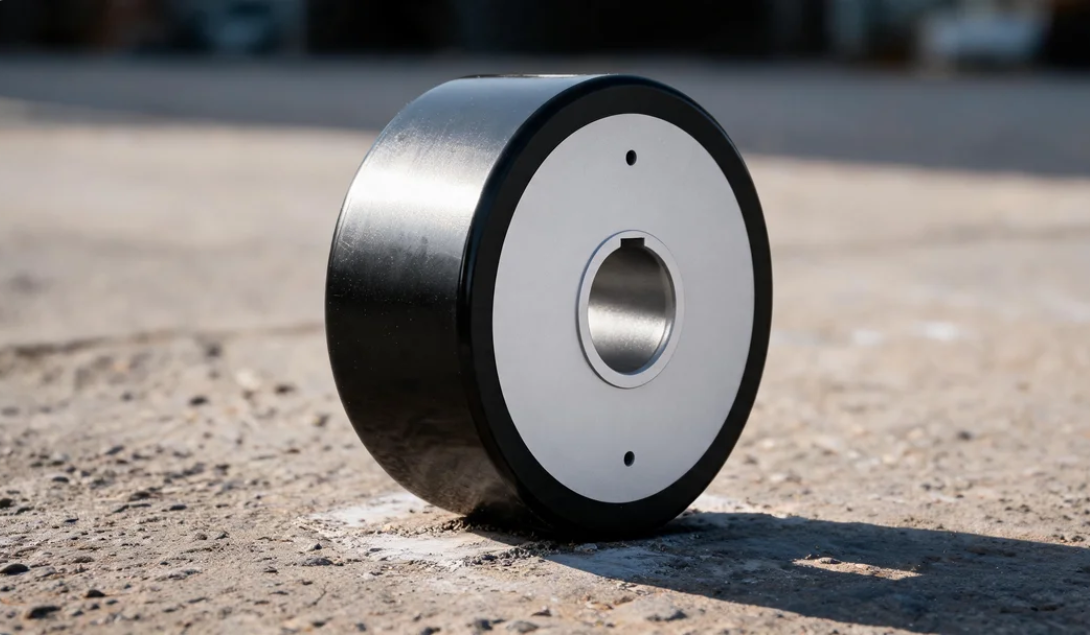
The other approach is to make the tire solid - a metal hub wrapped directly in a high-performance elastomer, the typical form being the solid polyurethane wheel. Polyurethane is an elastomer with excellent wear resistance. Made solid, it needs no internal air and naturally offers three advantages: no inflation needed, no puncture risk, and no blowout risk. More importantly, the load capacity, abrasion resistance, and weather resistance of a solid polyurethane wheel can be tuned through the compound formulation. Over the past decades it has built deep mature use in forklifts, AGVs, and conveyor equipment, making it a more proven and feasible route among outdoor airless options.
Comparison | Hollow Elastic Structure | Solid Polyurethane Wheel |
Load support | Honeycomb/spoke replaces air | Solid elastomer carries load directly |
Shock/comfort | Close to pneumatic | Moderate, adjustable by hardness |
Manufacturing | Complex, high cost | Casting, mature process |
Airless / no puncture | Yes | Yes |
Heavy-load durability | Early stage, unproven | Industrial, field-verified |
Maturity | Concept/special vehicles | Wide in forklift/AGV/conveyor |
Outdoor readiness | Still exploring | Mature, ready to scale |
As the comparison shows, for real outdoor work in engineering, logistics, and landscaping, the solid polyurethane wheel combines airless reliability with industrial maturity better than the alternatives. The rest of this guide focuses on solid polyurethane wheels - what outdoor problems they solve and how to select them without error.
Outdoor is not one operating condition; it is a collection of many. Different scenarios impose very different demands on a wheel, so selection must be discussed scenario by scenario. Below we break down four typical outdoor applications into operating conditions, core challenges, and selection direction.
Lawn mowers, garden trimmers, and golf carts work on grass, gravel, and pathways. These wheels tend to be larger in diameter with higher travel speeds, so they must balance wear resistance with adapting to turf terrain. The main pain points for garden machinery are pneumatic tires being punctured and fast wear causing frequent replacement. Solid polyurethane wheels reduce downtime from punctures and abrasion thanks to wear-resistant formulation. When selecting, prioritize abrasion indicators (the lower the DIN 53516 abrasion value, the better) and tread toughness to avoid brittle cracking.
Outdoor sweepers, waste transfer trucks, and high-pressure cleaners run on surfaces ranging from asphalt to brick to mud. Loads fluctuate widely and liquid media (water, cleaning agents) constantly wash over the wheels. This scenario demands impact resistance under heavy load, hydrolysis resistance in wet conditions, and stability after prolonged contact with ground media. Polyurethane's hydrolysis and corrosion resistance is a clear advantage here. During selection, focus on load capacity, media resistance, and friction performance on wet surfaces to avoid slipping. In HANKE's long-term validation for industrial cleaning equipment, lower-noise compounds such as HANKE's Saxflex 75A have also been widely applied where quiet operation is required.
As smart manufacturing extends beyond the workshop, a growing number of outdoor AGVs and heavy-duty material transfer vehicles now move goods between ports, industrial parks, and storage yards. These machines can carry several hundred kilograms to several tons, run for long continuous hours, and often must provide both non-slip traction and floor protection. The wheel selection logic for outdoor AGVs is close to that of indoor AGVs, but must add two extra criteria: weather resistance (sun, rain, temperature swings) and tear resistance. HANKE's Eamflex 93A high-wear-resistance tread is a direction already proven by workshop-grade AGVs for long-life, high-load drive scenarios; when moved outdoors, it only needs enhanced UV resistance and low-temperature toughness in the formulation.
Forklifts, manual hydraulic carts, tow trucks, and mobile scaffolding are equally common outdoors. These machines share one characteristic: downtime is expensive, and a wheel failure nearly equals the machine being disabled. A fully solid polyurethane wheel resists deformation under heavy load and handles higher static and dynamic loads. At the same time, heavy outdoor duty places high demands on the bond strength between hub and tread; impact and repeated torsion tend to cause cracking or even delamination at a weak bonding interface. So for heavy-load selection, look not only at tread hardness but also at how well the manufacturing process controls bond strength.
Outdoor Scenario | Core Challenge | Selection Focus | Tread Direction Reference |
Lawn / Garden machinery | Puncture, fast wear | Abrasion (DIN), tread toughness | 93A high-wear direction |
Sanitation / cleaning vehicles | Heavy load, wet, media | Load, hydrolysis, non-slip | 75A low-noise / 93A wear |
Outdoor AGV / warehousing | Heavy long hours, weather | Hardness, wear, UV | Eamflex 93A primary |
Heavy handling / towing | Impact, delamination risk | Bond strength, load | 93A high-load direction |
Whatever the scenario, outdoor wheel selection ultimately comes down to a few quantifiable dimensions. Master these four rulers and you can turn a vague requirement into actionable parameters instead of picking a wheel that merely looks right.
Hardness (Shore A) determines how much a wheel deforms under load. The harder the wheel, the less it deforms, the stronger its load capacity and wear resistance, but the poorer its shock absorption and the harder on the floor. The softer the wheel, the better the cushioning and floor protection, but the weaker the load capacity and the faster the wear. Outdoor selection cannot simply go as hard or as soft as possible - it must follow the real constraints of load and ground. A heavy-load forklift on hard pavement needs higher hardness for load; a lawn mower should keep some cushioning to minimize damage to the turf, provided it still meets the load requirement.
Outdoor surfaces are generally rough and contain gravel, so wear on wheels is far harsher than indoors. Abrasion resistance is usually measured by the abrasion volume (mm3) in the DIN 53516 abrasion test - the smaller the value, the more wear-resistant. On gravel, concrete, and brick surfaces, abrasion resistance directly decides the replacement cycle and the cost-effectiveness of each purchase. HANKE's Eamflex 93A system is specifically engineered for wear resistance, suiting outdoor heavy-load applications that put a premium on service life.
Outdoor wheels are exposed to the elements all year round, so aging resistance must be considered. Prolonged sun exposure can harden and crack the surface of some elastomers; in freezing regions low temperatures make material brittle; under high heat the material must not soften and deform; in rainy, humid environments it must resist hydrolysis. None of these can be answered by hardness alone. You must confirm how the chosen polyurethane formulation performs in terms of UV resistance, temperature resistance, and hydrolysis resistance in the target climate. For equipment covering multiple climates, this dimension is the one you cannot skip.
Outdoor ground is far more complex than indoor: wet asphalt, soft mud, uneven brick, and sharp gravel each place different demands on friction and tear resistance. Drive wheels need a sufficient friction coefficient to provide non-slip grip during start and braking; driven and guide wheels focus more on smooth rolling and tear toughness. In wet or muddy conditions, friction behavior and drainage deserve special verification.
Selection Dimension | Core Consideration | Lower Value Lean | Higher Value Lean | Key Trade-off |
Hardness | Load vs deformation | 75A cushioning/floor | 93A load/wear | Higher load = harder, rougher on floor |
Abrasion | Gravel-road life | High abrasion = short life | Low abrasion = long life | Wear gain often with higher hardness |
Weather | UV/temp/humidity | Standard environments | UV/hydrolysis-resistant formula | Weather formula needs material tuning |
Ground | Friction/tear | Low friction saves energy | High friction non-slip | Non-slip gains but wears faster |
You do not need to start from scratch to turn an outdoor requirement into a dependable wheel solution. Follow these four steps to cover the common pitfalls and save many rounds of back-and-forth with suppliers.
Write down the outdoor conditions your equipment faces: the upper load limit, how much each wheel carries, travel speed and incline, surface type (gravel / asphalt / mud), operating hours, and the local climate (whether it is rainy, freezing, or sun-exposed). The clearer the operating envelope, the more precisely you can set values on the four rulers.
On the basis of the operating conditions, set wheel diameter, mounting interface (hub bore, bearing, fixing method), hardness range, and wear target. For heavy load, lock hardness and load first; for lawns, prioritize wear and tread toughness; for outdoor AGVs, weight hardness, wear, and UV resistance together.
Outdoor scenarios are often not fully covered by standard products - wheel diameter, interface, hardness, and color may all need customization. Here you should evaluate whether the supplier can tune formulations and handle custom work, not just sell an off-the-shelf wheel. Taking HANKE as an example: its casting process and compound system support adjusting hardness and wear ratios per operating condition, and can fine-tune the formulation for outdoor UV resistance and low-temperature toughness. This is the difference between buying a standard part and turning it into a matched solution.
Outdoor conditions are complex. Even when parameters line up, it is wise to run a small-batch field validation - let the wheels run outdoors for a period to confirm wear, weather resistance, and non-slip behavior - before scaling up. HANKE's products, validated over the long term in the industrial scenarios above, have accumulated experience handling heavy load and abrasion, and can serve as a reliable baseline when you begin an outdoor solution.
Step | Key Input | Key Output | Common Pitfall |
1. Define envelope | Load, surface, climate | Operating conditions list | Vague conditions lead to wrong specs |
2. Lock parameters | Envelope | Diameter/hardness/wear target | Ignoring UV in hot climates |
3. Evaluate supplier | Custom needs | Formulation tuning capability | Picking off-the-shelf over matched |
4. Validate small batch | Field trial | Confirmed durability | Scaling before field validation |
Q1: What is the relationship between non-pneumatic tires and solid polyurethane wheels?
A1: Non-pneumatic (airless) tires broadly refer to any tire that does not rely on internal air to support its load, and include both hollow elastic structures and solid construction. A solid polyurethane wheel belongs to the solid route: a metal hub wrapped in polyurethane elastomer that carries the load directly, naturally airless, puncture-free, and blowout-free - a highly mature type of non-pneumatic solution for industrial outdoor use.
Q2: How hard should an outdoor wheel be?
A2: There is no single answer; it depends on load and ground. Heavy-load forklifts and transfer trucks on hard surfaces lean toward 93A high-hardness load-bearing; lawn machinery and floor-protection scenarios can choose 75A lower hardness for cushioning as long as the load requirement is met. The core is to lock the load constraint first, then choose the hardest hardness the ground can tolerate without damage.
Q3: Can polyurethane wheels survive heavy rain and strong sun outdoors?
A3: Yes, but the formulation must be confirmed. Long-term sun exposure needs a UV-resistant formula to avoid surface cracking; freezing cold requires material toughness to avoid brittleness; humid environments need hydrolysis resistance. During selection, define the target climate and confirm the UV, temperature, and hydrolysis performance with the supplier - all can be satisfied through formulation tuning.
Q4: For outdoor use, are solid polyurethane wheels or solid rubber wheels more wear-resistant?
A4: Under equal operating conditions, polyurethane is usually more wear-resistant than natural rubber or SBR, showing smaller abrasion and longer life, quantifiable by the DIN 53516 abrasion value. This is why polyurethane solid wheels last long in high-wear outdoor scenarios such as gravel and concrete.
Q5: Can outdoor AGVs use polyurethane wheels? What extra attention is needed?
A5: Yes. Outdoor AGVs build on the indoor AGV selection logic of hardness, wear, and non-slip, but must add three extra criteria: UV resistance, low-temperature toughness, and tear resistance, with corresponding formulation tuning. HANKE's Eamflex 93A high-wear tread is already validated in workshop-grade AGVs; moving outdoors just requires strengthening the weather-resistance formula.
Q6: Will the hub-tread interface delaminate under outdoor impact?
A6: Delamination risk depends mainly on the bonding process, not just the material. In heavy outdoor duty, repeated impact and torsion tend to cause cracking at a weak bond interface. So choose a supplier with reliable bond-strength control. In wheel production, HANKE controls hub sandblasting to remove the oxide layer, adhesive application, and casting precisely - precisely to make the bonding interface solid and reduce delamination risk under outdoor conditions.
Q7: Can size and hardness be customized for outdoor wheels?
A7: Yes. Outdoor wheel diameter, mounting interface, hardness, and color often require custom work. Choosing a supplier with formulation tuning capability lets you turn the target operating condition into concrete parameters, avoiding downtime caused by a standard part mismatching the actual conditions.
Q8: Should I trial a small batch first or order at scale?
A8: It is recommended to validate a small batch first. Outdoor conditions are complex - even when parameters match, it is wise to run the wheels for a period to confirm wear, weather resistance, and non-slip performance before scaling. This significantly reduces the risk of rework and batch scrap.
Harsh outdoor conditions are steadily pushing more equipment toward non-pneumatic solutions, and the solid polyurethane wheel is among the mature, reliable, and scalable routes available today. Its solid construction removes the chronic troubles of pneumatic tires - puncture, leak, blowout, and pressure maintenance - while its tunable formulation covers the four major outdoor scenarios of lawn, sanitation, outdoor AGV, and heavy-duty handling. Select by parameters rather than by feel: master the four rulers of hardness, wear, weather resistance, and ground adaptability, then run through the workflow from operating conditions to field validation. This is how you avoid the common outdoor selection traps and keep equipment running steadily across gravel, mud, and blazing sun.
HANKE (Wenzhou) Polyurethane Technology Co., Ltd. traces its technical origins to a 1989 polyurethane elastomer casting equipment R&D team, with more than 35 years of experience in the polyurethane industry. The company holds 52 technical achievements covering polyurethane formulation R&D, hub structure design, mold engineering, and product appearance. Its wheels have been verified on the production lines of leading companies including Mercedes-Benz, Land Rover, Changan Automobile, Geely, Kinco, and Tennant.
HANKE's manufacturing system covers the full process from sandblasting, adhesive application, and casting to finished-product inspection - equipped with a CHOTEST coordinate measuring machine (1 um precision) for full inspection of key dimensions on every batch. Guided by the mission of making the movement of people and goods safer, HANKE is committed to becoming an influential roller and wheel manufacturer in China's intelligent logistics industry.

