
 EN
EN
Quick Links
There is no fixed winner between pneumatic tires and solid tires - only the right match for the operating condition. On smooth, high-speed paved surfaces, pneumatic tires still hold clear advantages in purchase price, cushioning and rolling resistance. In outdoor heavy-duty environments with gravel, mud, sharp debris and long sun exposure, polyurethane solid tires are usually the more dependable choice because their airless structure eliminates punctures, pressure maintenance and blowout risk.
The real differentiator is Total Cost of Ownership (TCO). Comparing purchase price alone is misleading. A complete TCO model adds purchase, replacement, maintenance labor, downtime loss and safety risk across the whole service life, then divides by usable life to obtain a comparable cost per unit of time. In gravel heavy-duty duty, a cheaper pneumatic tire can end up costing more in year one once replacements and stoppages are counted.
This guide does not make the decision for you. It lays out the genuine strengths and weaknesses of both tire types, builds a transparent five-cost TCO framework, walks through a worked example with clearly stated assumptions, and provides a scenario-based selection table - so purchasing managers and fleet managers can run the numbers for their own operation. The framework itself is drawn from HANKE's engineering practice in outdoor and heavy-duty wheel applications, but every assumption is left open for the reader to replace with real data.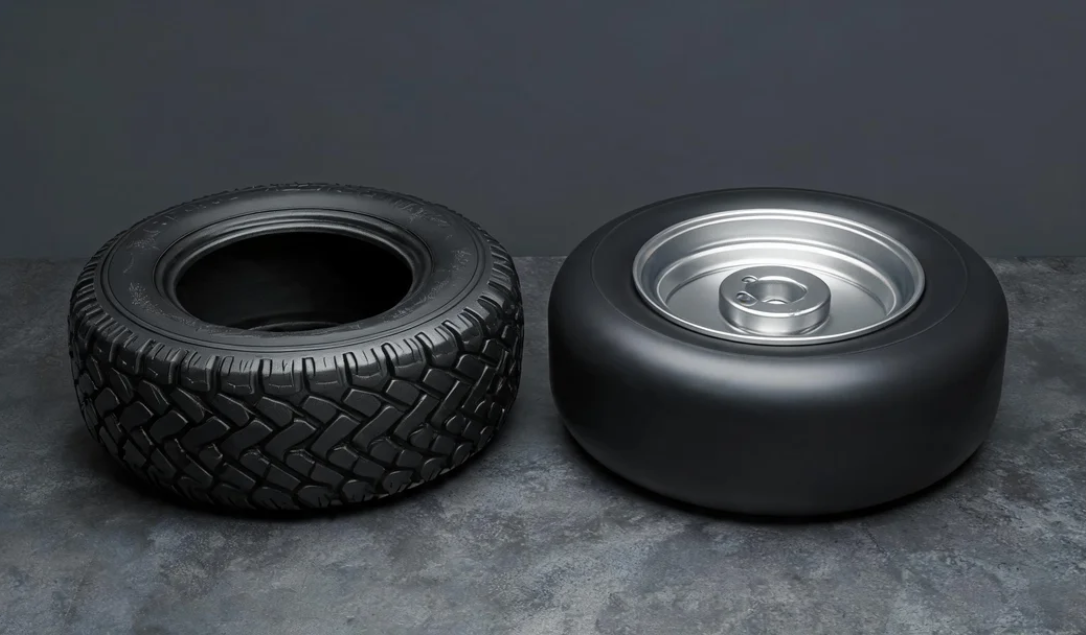
Any tire selection discussion that starts with a predetermined answer has already lost its educational value. Pneumatic tires and solid tires - here we focus mainly on polyurethane solid tires - work on completely different structural principles. Each was created for certain operating conditions, and each pays a real price in others. Before agonizing over the choice, laying out the genuine strengths and weaknesses of both sides without bias is the only fair starting point.
Start with the advantages of pneumatic tires, because they are often buried under one-sided marketing talk. First, the initial purchase price is low, the technology is mature and supply is everywhere - friendly to budget-sensitive operations. Second, the compressible air inside provides real cushioning: on smooth surfaces the ride is stable and comfortable for both operators and the goods being moved. Third, rolling resistance is low, which saves energy on smooth, long-distance, medium-to-high-speed transport. Fourth, industry familiarity is high and repair services are common, so operators need no learning curve. These strengths explain why, on well-maintained surfaces without frequent sharp debris, and where cost and comfort matter most, pneumatic tires remain a reasonable - even superior - choice.
Now look at what solid tires genuinely bring. Their core value is that the structure itself removes several chronic pain points of pneumatic tires. First, no air means no inflation, no punctures and no blowouts - there is no internal chamber and no pressure, so the failure modes of leaking, pressure loss and the sudden energy release of a blowout simply do not exist. Second, service life is longer and wear can be engineered: hardness and formulation can be tuned to the actual load. Third, maintenance is minimal - no checking or topping up pressure machine by machine - which matters for fleets managed as a whole. Fourth, load-carrying capacity is stable because the structure, not the air pressure, bears the load. These are the reasons solid tires win on gravel, mud, heavy loads, rough terrain and open sun - exactly the conditions where pneumatic tires are most vulnerable.
The table below is not a scoreboard. It simply maps where each tire type is strong, and makes clear that both have duties they are built for. The real question is not which type is better, but which column your operating condition is closer to.
Dimension | Pneumatic Tire | Polyurethane Solid Tire | Better Fit (Duty-Dependent) |
Initial purchase price | Lower | Higher | Budget-sensitive duty: pneumatic |
Shock absorption / ride comfort | Good (compressible air) | Firmer (relies on compound elasticity) | Comfort-first duty: pneumatic |
Rolling resistance / energy use | Low on smooth surfaces | Slightly higher | Long smooth hauls: pneumatic |
Puncture and air leaks | Prone to punctures and leaks | No air chamber, no punctures | Outdoor gravel duty: solid |
Blowout risk | Exists (heavy load + heat + aging) | Structurally eliminated | Heavy-duty safety: solid |
Service life / wear resistance | Varies with pressure and surface | Long, controllable and measurable | Frequent abrasion: solid |
Maintenance burden | High (pressure checks + repairs) | Near zero (no inflation needed) | Centralized fleet management: solid |
Load stability | Varies with air pressure | Structurally stable | Steady heavy loads: solid |
Reading the table this way reframes the discussion: the two tire types are not rivals fighting for one throne, they are tools for different duties. The genuine question is never which type is better in the abstract, but which duty your equipment actually runs in. This is the objective stance this article keeps - give the reader the real trade-offs and let selection return to the operating condition.
The previous section compared neutral capability. Selection, however, always happens inside a specific duty. When the scene shifts to outdoor heavy-duty material handling - forklifts, transfer carts, tow tractors and material handling trucks working on gravel, mud, rough terrain and open sun - several relative weaknesses of pneumatic tires are amplified, while the strengths of solid tires come into full play. Note the words relative and in this duty: this is not a dismissal of pneumatic tires in general.
On construction sites, freight yards and loading aisles, sharp stones and scattered metal scraps are the natural enemy of a pneumatic tire. A single puncture can leave a loaded transfer cart stranded in the middle of the yard - cargo has to be unloaded, the operation stops and people wait. Outdoor sites are often far from repair shops, making patching and replacement slow and difficult. For transport and logistics routes that depend on continuous equipment operation, the downtime loss from one puncture is usually far higher than the price of the tire itself. A solid tire, having no internal cavity, has no such failure mode by design.
Pneumatic tires must be checked regularly and kept at the correct pressure. Too high a pressure reduces grip; too low a pressure accelerates wear and can even cause overheating. In a fleet of dozens of vehicles, checking pressure machine by machine is itself a significant maintenance bill. The more frustrating part is that a pressure problem is usually discovered only after the machine starts behaving abnormally. That lag in detection is itself a hidden cost that rarely appears in a simple purchase-price comparison.
Heavy load, high temperature and abnormal pressure often arrive together. Heavy load keeps the tire under continuous stress; summer ground heat pushes internal pressure higher; and aging sidewalls thinned by wear add a third factor. Any of these can trigger a blowout. On equipment carrying heavy goods, a blowout does not only interrupt the operation - it can endanger people nearby, tip the load and damage the machine. This is the weakness that outdoor heavy-duty users must take seriously: not because a blowout is certain, but because the risk is real and the consequences are expensive. A solid tire eliminates this mechanism entirely through its airless structure.
It is worth stressing that this amplification is conditional - it holds when the duty actually contains gravel, heavy loads and sun exposure. If the equipment only runs light loads at low speed on smooth hard pavement, these weaknesses largely disappear, and the pneumatic tire's low purchase price and good cushioning come to the fore. That is exactly why the next chapter quantifies the trade-off with numbers instead of adjectives.
Pros and cons, however well argued, remain qualitative. What makes a decision concrete is comparing costs. Total Cost of Ownership (TCO) adds up every cost an item generates from purchase, through use and maintenance, to disposal and replacement, then divides by service life to obtain a comparable cost per unit of time. It is closer to the truth than comparing purchase prices alone, because it includes time and hidden costs. For outdoor heavy-duty handling equipment, TCO is typically built from five cost components.
Cost Component | Pneumatic Tire | Polyurethane Solid Tire | Notes |
1. Purchase cost | Lower | Higher | The visible price per wheel |
2. Replacement / service-life cost | Short life, replaced often | Long life, cost spread thin | Measure by cost per unit of service time |
3. Maintenance labor | High (pressure checks / patching) | Near zero (no inflation) | Multiplies wheel by wheel in large fleets |
4. Downtime loss | High (puncture / blowout stoppages) | Low | One stalled vehicle disrupts the whole flow |
5. Safety / risk cost | High (blowout hazard) | Low (structurally eliminated) | Highly hidden, but potentially the most expensive |
To make the framework operational, here is a transparent worked example. The assumptions are deliberately stated as typical industry-scale values, so readers can follow the calculation logic and substitute their own data before drawing any conclusion. Run the same assumptions with the duty changed from outdoor heavy-duty gravel to smooth hard pavement, and the conclusion can reverse. This is exactly the value of TCO: it takes no side, it only follows the data and the duty.
Scenario A - outdoor heavy-duty on gravel. A 3-ton outdoor forklift works 300 days a year, 8 hours a day, on a mix of gravel and hard concrete, frequently meeting sharp debris and open sun. The annualized cost for one wheel position is estimated below.
Calculation Item | Pneumatic Option | PU Solid Tire Option |
Wheel purchase price (example) | Approx. RMB 400 | Approx. RMB 1,200 |
Expected service life (outdoor) | About 6-9 months (incl. puncture / blowout replacements) | About 18-24 months |
Replacements in year one | About 1.5-2 times | About 0.5 times |
Annual purchase + replacement cost | About RMB 800 | About RMB 600-700 |
Maintenance hours per wheel per year | About 8-10 hours | Near zero hours |
Annual downtime loss (occasional punctures / blowouts) | Several incidents; hundreds to thousands of RMB | Extremely low; almost no tire-related stoppages |
Blowout safety risk | Present; uncontrolled cost | Structurally eliminated |
Total first-year cost | Medium-high, with hidden items | Slightly higher visible cost, very low hidden cost; often better overall |
The point of the table is not the example numbers themselves but the logic they reveal. In the gravel heavy-duty scenario, the pneumatic tire is cheap to buy but needs replacing 1.5-2 times a year; add maintenance labor and puncture or blowout downtime, and its first-year total cost can approach or even exceed that of the more expensive solid tire. Once service life stretches, maintenance and downtime fall to near zero, and safety risk disappears, the solid tire's expensive label is redefined - it costs more up front, but wins across the full service cycle.
Scenario B - smooth hard pavement. Now consider a duty where the pneumatic tire wins on the math: the same forklift, but on smooth hard concrete with no sharp debris and no sun exposure, at modest daily intensity. Puncture and blowout probability drops sharply, pneumatic service life extends noticeably, and its low purchase price and good cushioning show their value, while the solid tire's higher initial cost stands out. In this scenario the pneumatic TCO can be more competitive. The comparison makes one point: a TCO conclusion is not fixed - it depends heavily on the duty assumptions. Selection must therefore start by defining the actual operating conditions; only then does the calculation mean anything.
Detail one: measure life in time, not only in distance. Outdoor handling equipment tends to stop and start frequently, with repeated loaded acceleration, braking and lifting. Wear comes more from load and start-stop impact than from distance traveled, so evaluating the replacement cycle in months of service is closer to reality than tracking mileage alone.
Detail two: downtime must include knock-on effects. When one vehicle stalls in the middle of a yard, the ripple effect covers the whole loading and unloading flow, the labor hours of waiting staff, and sometimes customer delivery deadlines. The stoppage cost of a single machine is almost always underestimated.
Detail three: do not ignore batch consistency. For both pneumatic and solid tires, batch stability directly affects fleet replacement cycles and spare-part management. When choosing a supplier, evaluate their quality-control capability, not just the unit price.
This section deliberately avoids rushing to a conclusion. Instead, it organizes a scenario-matching table based on typical operating conditions. The final decision should be made by the equipment manager, combining the fleet's actual duty, the equipment's rated load and wheel-size envelope, and the technical advice of the supplier.
Typical Duty | Main Challenge | Pneumatic Tire | PU Solid Tire | Lean Toward |
Smooth hard pavement, low-medium speed, light load | Cost sensitivity, ride comfort | Low purchase price, good cushioning, energy-saving | No clear advantage; higher purchase price | Pneumatic |
Long smooth hauls, medium-high speed | Low rolling resistance, energy saving | Low rolling resistance, mature technology | Slightly higher rolling resistance | Pneumatic |
Gravel / mud / outdoor heavy duty | Punctures, blowouts, wear | Short life, high maintenance, some risk | Puncture-free and blowout-free, wear-resistant, long life | Solid |
Frequent start-stop, heavy load and unload | Impact, wear, downtime | Under-pressure wear, blowout risk | Structural load capacity, near-zero maintenance | Solid |
Delicate floors (epoxy, etc.) | Indentation, floor protection | Cushioning via air pressure | Needs a low-hardness floor-protection compound | Depends on hardness formulation |
High / low temperature and open sun | Aging, weather resistance | Sidewall aging and embrittlement | Needs UV- and hydrolysis-resistant formulation | Depends on formulation |
Behind this table lies a universally applicable selection method: there is no one-size-fits-all answer. Under the same budget and load requirement, a difference in surface material and operating intensity is enough to push the conclusion in opposite directions. A disciplined selection therefore starts with the equipment manager fully documenting the operating conditions, then judging against a table like this - based on objective data, not on whichever marketing message is loudest.
The content so far has stayed objective so that readers can build trust in the analysis. This chapter is an honest focus: if the operating condition genuinely falls into the outdoor heavy-duty, gravel, frequent start-stop and long sun-exposure zone, then a polyurethane solid tire is a direction worth serious evaluation. Below are its concrete advantages in this class of duty, offered as reference points for deeper investigation.
Value one: wear resistance that can be engineered and measured. Polyurethane generally outperforms natural rubber and SBR in abrasion resistance, usually quantified by the DIN 53516 abrasion loss value (mm³) - the lower the number, the more wear-resistant the material. On high-wear gravel surfaces, this turns abrasion resistance into a measurable, comparable specification rather than a vague claim of being wear-resistant. HANKE publishes DIN 53516 values for its tread compounds so that customers can compare grades on paper before they test on site.
Value two: a formulation selected for the duty. Hardness governs the balance between load capacity and deformation. For heavy loads on hard ground, a high-wear tread grade extends service life and resists gravel abrasion; for delicate floors or noise-sensitive sites, a floor-protection grade is the better direction. HANKE's two tread compound systems - Eamflex (93A high-wear-resistance, aimed at heavy loads on hard ground) and Saxflex (75A floor protection, aimed at protecting floors and lowering noise) - are designed exactly for matching the tread direction to the duty: one supplier can point you toward a heavy-duty wear-resistant formulation or a floor-protective low-noise formulation.
Value three: bonding and quality control as a complete system. Outdoors, frequent impact and wide temperature swings make the bond between the hub and the tread the critical reliability point. This tests the supplier's key processes - sandblasting, adhesive application, casting - and its batch-level inspection discipline. As a reference point, HANKE runs full inspection of critical dimensions with a CHOTEST coordinate measuring machine (1 µm-class accuracy) and has accumulated long-term engineering practice in heavy-duty drive wheels on automotive production lines for Mercedes-Benz and Land Rover. Use these as checkable evidence when evaluating a supplier's technical foundation, not as decoration.
Based on the three capabilities above, HANKE's support for outdoor heavy-duty applications is not about simply selling a wheel. It starts by clarifying the operating conditions - load, number of wheel positions, wheel diameter, surface type, operating temperature - then the technical team evaluates formulation direction and structure, validates with a small batch, and only then scales up. Even if the final conclusion is to stay with pneumatic tires for now, we prefer to do the duty analysis first so the customer makes the decision with clear data. The choice always stays with the customer.
If, after Sections 4 and 5, you lean toward solid tires, this section translates the need into technical parameters through a generic path. It works equally well in reverse: run through the checklist item by item, and whatever you finally choose, you will avoid the most common mistakes.
Selection Ruler | What It Measures | What to Watch |
Hardness (Shore A) | Load capacity vs. deformation | Higher hardness carries heavy loads; medium hardness protects floors |
Abrasion resistance | DIN 53516 abrasion loss value | Lower value = more wear-resistant; the key indicator on gravel |
Tear / weather resistance | UV, water immersion, temperature swings, impact | Long-term sun and rain outdoors make anti-aging and tear strength critical |
Floor compatibility | Friction / grip / indentation | On smooth or delicate floors, balance grip with floor protection |
Step | Input / Judgment | Output |
1. Define the operating envelope | Load, wheel count, surface, temperature, daily hours | A clear applicable range |
2. Lock the key parameters | Hardness, wear resistance, tear resistance, bonding | A target parameter list |
3. Evaluate supplier capability | Formulation tuning, weather resistance design, QC system | A shortlist of candidate suppliers |
4. Validate with a small batch | Run a real-surface trial for a period | Trial data and feedback |
5. Scale up delivery | Locked parameters, consistent batches | Full-scale rollout |
The five steps are meant to be worked through in order. Skipping step one is the most common mistake - parameters locked before the envelope is defined often fail on site. HANKE's application engineers use this same sequence when reviewing outdoor heavy-duty enquiries, and they treat envelope definition as the step that decides most of the outcome.
Example: an outdoor transfer cart with a 2-ton payload on 4 wheel positions (about 500 kg per wheel), running 8 hours a day on hard concrete mixed with some gravel, requiring wear resistance and the ability to withstand heavy impact. Walking through the workflow: the operating envelope is outdoor heavy-duty on gravel and concrete; the locked parameters prioritize high wear resistance with tear and weather resistance alongside; the supplier evaluation asks whether the vendor can recommend a high-wear formulation for heavy loads on hard ground; and a small-batch trial is run before scaling. Against HANKE's tread systems, a 2-ton gravel duty of this kind typically lands in the high-wear grade (Eamflex 93A class). This is only directional guidance - the final decision returns to the real load, surface and temperature data, evaluated and confirmed by the technical team.
Q1: Is a solid tire really much more expensive than a pneumatic tire?
On purchase price alone, yes. But the purchase price is only one part of TCO. Spread replacement frequency, maintenance labor, downtime loss and safety risk across the whole service life, and in outdoor heavy-duty gravel duty a solid tire is often no more expensive - sometimes cheaper overall. On smooth pavement with light loads, however, the pneumatic tire can be the more economical choice. Run the numbers for your own duty before concluding.
Q2: Do pneumatic tires still have real advantages today?
Absolutely. Low initial cost, good cushioning, low rolling resistance and mature, widely available technology are exactly why pneumatics remain the mainstream choice in many applications. The question is not which type will eliminate the other, but which fits your operating condition. On smooth surfaces pneumatic tires are still an excellent choice; outdoor heavy-duty gravel is where solid tires fit better.
Q3: Will a polyurethane solid tire wear out too quickly in outdoor heavy-duty use?
Polyurethane generally outperforms natural rubber and SBR in abrasion resistance, usually quantified by the DIN 53516 abrasion loss value - the lower the number, the more wear-resistant. Gravel surfaces demand high abrasion resistance, so focus on this indicator and select a high-wear tread grade - for example from HANKE's Eamflex 93A high-wear system - rather than judging by hardness alone.
Q4: Are solid tires too heavy, and will they reduce the equipment's payload?
A solid tire is usually heavier than a pneumatic tire of the same size, but its load-carrying capacity is more stable because it does not vary with air pressure. As long as the wheel stays within the equipment's rated load and structural envelope, heavy-duty transport is exactly the zone where solid tires perform best. Evaluate this against the equipment's load margin.
Q5: Will outdoor sun and rain make a polyurethane solid tire age and crack?
Polyurethane needs UV and hydrolysis resistance designed into the formulation to stay stable in long-term outdoor exposure. When selecting, confirm that the formulation is optimized for outdoor weathering. A standard indoor formulation used outdoors can face surface cracking and aging - this is a direct question to ask the supplier.
Q6: Will a solid tire leave marks or damage the floor?
The higher the hardness and the heavier the load, the higher the indentation risk on a delicate floor. If the site uses an epoxy or other fragile floor, choose a medium-hardness grade oriented toward floor protection - a formulation in HANKE's Saxflex 75A class balances load capacity with floor protection. Floor material is a key variable that must be included in selection.
Q7: Under outdoor impact, will the tread separate from the hub?
Delamination risk depends mainly on the hub-to-tread bonding process and quality control. Outdoor scenarios with strong impact and wide temperature swings demand more from the bond. When selecting a supplier, examine their key process quality - sandblasting, adhesive application, casting - and their batch inspection discipline, rather than asking about the formulation alone. HANKE's bonding process, for example, follows controlled sandblasting, adhesive application and casting procedures with batch-level records.
Q8: Can the hardness and size of a solid tire be customized?
Yes. Polyurethane solid tires are commonly customized by size and hardness, covering different diameters, widths, load ratings and surface conditions. When customizing, provide the load, number of wheel positions, wheel diameter, surface type and operating temperature so the technical team can evaluate the formulation and structure.
Q9: When switching to solid tires for the first time, should we trial a small batch or order at scale?
A small-batch trial is strongly recommended. Run the wheels on the real surface for a period and confirm that load capacity, wear resistance, floor protection and weather resistance all meet expectations before scaling up. The validate-first, then-scale rhythm keeps trial-and-error cost to a minimum.
Q10: How can we judge whether a supplier gives objective professional advice?
Look at three things. First, whether they can match the formulation to the duty - giving different directions for different scenarios. Second, whether their key processes and quality control are systematic - bonding stability and batch consistency. Third, whether they can frankly point out scenarios where solid tires are not the right fit. A supplier willing to say that a pneumatic tire suits your duty better is usually the one worth trusting.
Back to the opening question - solid tire or pneumatic tire for outdoor heavy-duty vehicles? In one sentence: there is no fixed winner, only the better-matched selection. On smooth surfaces, with light loads, comfort priorities and budget sensitivity, the pneumatic tire remains a reasonable - even superior - choice. In outdoor heavy-duty duty with gravel and mud, frequent start-stop and long sun exposure, the polyurethane solid tire's advantages of no inflation, no punctures, no blowouts and long service life come into full play - the pattern HANKE observes across outdoor forklift and transfer-cart fleets.
The reliable decision method is to first clarify your real operating conditions and cost structure, then run a transparent TCO calculation, locate your duty in a scenario table, and - when in doubt - use one small-batch trial to verify the judgment. Whichever type you finally choose, arriving at the negotiation with a method and a complete cost ledger gives you a solid footing - and a better ability to tell which suppliers are giving you objective advice and which are simply trying to sell you a product. HANKE's own selection reviews apply the same standard: when the duty analysis points to a pneumatic tire, that is what the customer is told.

