
 EN
EN
Quick Links
▎Key Takeaways
► PU bonded wheel service life is a function of four variables: load, speed, floor condition, and tread hardness. Lab tests (DIN 53516) provide a baseline, but real-world correction factors can range from 3x to 5x.
► Tread wear (mm) is the most direct replacement indicator: schedule replacement at 30% wear of initial thickness, mandatory replacement at 50% — beyond this, the bond interface stress approaches its limit.
► HANKE Eamflex 93A tread delivers 2-3x the service life of rubber wheels in AGV applications (DIN 53516 abrasion: 0.03-0.08 cm³/1.61km), while Saxflex 75A prioritizes floor protection.
► Four early warning signals predict replacement needs: bearing temperature >70°C, tread hardness deviation >5 Shore A, wheel roundness deviation >0.3 mm, and tread crack depth >1 mm.
► A replacement log tracking mileage (every 500 km tread measurement recommended) or runtime (every 6 months for light-duty, every 3 months for heavy-duty) significantly reduces unplanned downtime.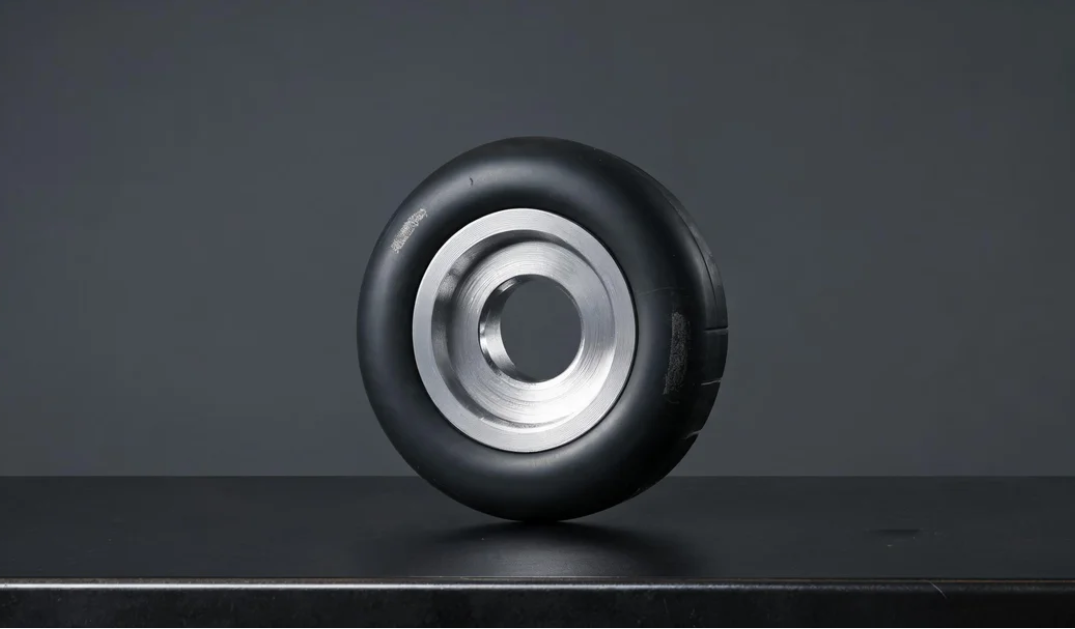
Parameter | Value | Notes |
DIN 53516 Abrasion (Eamflex 93A) | 0.03-0.08 cm³/1.61km | Lab standard, apply field correction |
DIN 53516 Abrasion (Saxflex 75A) | 0.08-0.15 cm³/1.61km | Softer compound, lower wear resistance |
Tread warning threshold | Wear ≥ 30% of initial thickness | Plan replacement |
Tread mandatory replacement | Wear ≥ 50% of initial thickness | Replace immediately |
Bearing temperature alarm | >70°C | Grease degradation above this threshold |
Hardness deviation alarm | >5 Shore A | Indicates material aging |
Roundness deviation alarm | >0.3 mm | Causes vibration and instability |
Crack depth alarm | >1 mm | Risk of propagation to bond layer |
Inspection (light-duty) | Every 6 months | Or every 3,000-5,000 km |
Inspection (heavy-duty) | Every 3 months | Or every 1,500-3,000 km |
Recommended measurement | Every 500 km | Use caliper or tread depth gauge |
In industrial equipment maintenance, PU bonded wheels are often overlooked. Unlike standard rolling element bearings with defined L₁₀ life calculations or hydraulic fluids with fixed change intervals, PU wheel service life is affected by four interdependent variables: load, speed, floor condition, and ambient temperature. No single rating plate can capture all scenarios.
A common real-world example: an AGV operates for two years before one wheel fails unexpectedly, while other wheels from the same batch continue running normally. The difference can come from installation position, travel path frequency, or even floor cleanliness variations.
This guide provides a practical method for predicting PU wheel service life and determining replacement timing, based on DIN standard test data and field experience accumulated by HANKE through thousands of AGV drive wheel applications.
When a PU tread contacts the floor, the applied load generates compressive and shear stresses within the tread material. Higher loads increase unit-area contact pressure, accelerating wear non-linearly.
Test data shows: when tread contact pressure increases from 5 MPa to 8 MPa, the wear rate approximately triples (2.5x). For a drive wheel designed for 500 kg, running at 800 kg actual load can reduce service life to roughly 1/3 of the design value.
Common conditions that drive actual load above design values:
• Slopes on AGV travel paths — drive wheel load increases by 20-40% during climbing
• Uneven load distribution — one wheel on a four-wheel vehicle may carry 1.5x the theoretical uniform load
• Irregular floor surfaces — impact loads on uneven floors can reach 2-3x the static load
Operating speed directly affects tread heat generation. PU elastomers produce internal hysteresis heat during repeated compression-recovery cycles. Higher speeds mean more deformation cycles per unit time, causing faster temperature rise.
At 25°C ambient, AGV running at 0.5 m/s typically raises tread temperature 5-10°C above ambient. At 2 m/s, tread temperature rise reaches 20-30°C. Every 10°C increase reduces PU tensile strength and wear resistance by approximately 5-8%.
In HANKE's 90-day continuous aging test, Eamflex 93A tread at 1 m/s showed hardness change <2 Shore A and wear retention >95%. At 2.5 m/s, hardness change reached 4-5 Shore A and wear retention dropped to 82%.
The floor is the direct interface with the PU tread. Surface roughness, cleanliness, and material determine the actual wear rate.
• Sealed epoxy / sealed concrete (Ra 0.5-1.5 μm): standard condition, Eamflex 93A life 15,000-25,000 km
• Unsealed concrete (Ra 3-8 μm): wear rate 2-3x faster, life 6,000-10,000 km
• Metal grating / steel plate: abrasive wear dominant, life 3,000-5,000 km
• Grit or metal debris on floor: localized wear 5-10x standard rate
When estimating wheel life, apply a floor correction factor: use sealed epoxy as baseline (factor 1.0), unsealed concrete 0.3-0.5, metal floor 0.2-0.3.
PU tread hardness, measured in Shore A, is the core material parameter affecting wear resistance. The relationship between hardness and abrasion resistance is not strictly linear.
Test data: 75 Shore A (Saxflex): DIN 53516 abrasion 0.08-0.15 cm³/1.61km — best floor protection, low noise, suitable for clean rooms and soft floors. 85 Shore A: 0.05-0.10 cm³/1.61km — balanced performance. 93 Shore A (Eamflex): 0.03-0.08 cm³/1.61km — highest wear resistance, best for heavy-load AGV and hard floors.
Selection guidance: For epoxy-floored automated warehouses where floor protection matters, choose Saxflex 75A. For concrete factory floors requiring longer maintenance intervals, choose Eamflex 93A. Neither is inherently superior — each targets a specific application profile.
Predicting when to replace a wheel requires understanding wear rate. Here is a simplified calculation method:
Step 1 — Establish baseline wear rate. Under DIN 53516 standard conditions (20N load, 40 m/min linear speed, 60-grit abrasive paper), Eamflex 93A tread has an abrasion volume of 0.03-0.08 cm³/1.61km. For a 200 mm diameter, 40 mm wide drive wheel: 0.05 cm³ abrasion corresponds to approximately 0.002 mm of tread depth per revolution. At ~0.628 m circumference per revolution, this equals about 0.003 mm tread wear per km.
Step 2 — Apply field correction factors. Actual wear rate = baseline rate × load correction × floor correction × speed correction.
Parameter | Range | Correction Factor |
Load ratio (actual/rated) 0.5-1.0 | Normal | 1.0 |
Load ratio (actual/rated) 1.0-1.5 | Overloaded | 1.5-3.0 |
Floor: sealed epoxy | Ra 0.5-1.5 μm | 1.0 (baseline) |
Floor: unsealed concrete | Ra 3-8 μm | 2.0-3.0 |
Floor: metal grating | — | 3.0-5.0 |
Speed: 0.5-1.0 m/s | Low | 1.0 |
Speed: 1.0-2.0 m/s | Medium | 1.2-1.5 |
Speed: >2.0 m/s | High | 1.5-2.0 |
Example calculation: An AGV drive wheel rated at 800 kg, actual load ~600 kg (load factor 0.75, correction 1.0), running on sealed concrete (correction 2.5), at 1.2 m/s (correction 1.3). Actual wear rate = 0.003 mm/km × 1.0 × 2.5 × 1.3 = 0.00975 mm/km. With initial tread thickness of 15 mm and replacement threshold at 30% wear (4.5 mm), theoretical life ≈ 4.5 ÷ 0.00975 ≈ 462 km. Applying a 70-80% safety factor for installation variance and dynamic loads, schedule inspection at 325-370 km.
Tread thickness wear is not the only indicator for replacement. The following four abnormal signals, even with adequate tread remaining, require immediate attention.
Bearings are the critical internal components of a bonded wheel. Abnormal operating conditions show up first as bearing temperature rise. Normal AGV drive wheel bearing temperature should be less than ambient +15°C. If infrared measurement shows bearing area temperature exceeding 70°C, grease degradation has begun. Continued operation can lead to bearing seizure within weeks — a seized bearing damages the hub bore beyond repair.
Common causes: excessive preload, seal friction, insufficient lubrication, or periodic impact loads from wheel roundness deviation.
PU material undergoes a softening-then-hardening cycle during service. In the initial 0-200 km, stress relief in the tread surface may cause slight softening (-1 to -2 Shore A). During stable operation, hardness stabilizes. In late life, oxidation and increased cross-link density cause gradual hardening.
Check tread hardness monthly with a Shore A durometer. Deviation within ±3 Shore A from the factory specification is normal. At ±5 Shore A or more, the material has undergone significant aging — elasticity is reduced, and continued use risks cracking or sudden tread failure.
HANKE Eamflex 93A has a factory hardness of 93±2 Shore A. After 12 months of continuous AGV operation, field data shows normal wear maintains 91-94 Shore A. If hardness rises to 98-100 Shore A, the tread is over-hardened and requires immediate replacement.
Long-term single-direction operation can cause uneven tread wear, making the wheel non-circular. Test method: lift the wheel off the ground, rotate it manually, and observe the gap between the tread edge and a fixed reference point. If the gap varies by more than 0.3 mm, roundness deviation is affecting running stability.
Roundness deviation has a cumulative effect: larger deviation creates higher impact loads per revolution, accelerating both uneven wear and bearing damage. In AGV applications, 0.3 mm roundness deviation can reduce positioning accuracy by 1-2 mm — a collision risk in narrow passages like rack aisles or doorways.
Tread cracking is a typical sign of PU material fatigue. Cracks usually appear first at the tread edges — the stress concentration zone. Distinguishing surface micro-cracks (0.1-0.3 mm depth, normal aging) from concerning cracks (>1 mm) is critical.
Inspection: Use a fine probe or fingernail to test crack depth. Cracks <0.3 mm with limited quantity — continue operation with increased monitoring. Cracks >1 mm or networked cracking — the tread material is in end-of-life stage, schedule replacement within 1-2 weeks. An emergency signal: visible gap between tread and hub indicates bond layer failure — stop immediately.
A 10-minute on-site inspection protocol for routine maintenance and troubleshooting:
Step 1 — Visual inspection. Lift the wheel, rotate it manually, and check for visible cracks, bulges, missing compound, or embedded debris. Check the hub surface for rust — hub corrosion indicates seal failure.
Step 2 — Tread thickness measurement. Using a caliper or tread depth gauge, measure at four points around the circumference (0°, 90°, 180°, 270°). Take the minimum value as the decision basis.
Step 3 — Hardness check. Take three Shore A readings at the tread center, average them. Clean the tread surface before measurement to avoid grit interference.
Step 4 — Bearing check. Grasp the wheel on both sides and shake axially and radially. Visible play or wobble indicates excessive bearing clearance. Normal bearings should have no detectable play.
Step 5 — Temperature check. Run the AGV for 30 minutes continuously, then measure hub bearing area temperature with an infrared thermometer. Compare across all wheels on the same vehicle. A wheel running 10°C above the others should be flagged.
Inspection Item | Normal | Caution | Replace |
Tread remaining thickness | ≥70% of initial | 50%-70% | <50% |
Hardness deviation | ±3 Shore A | ±3-5 Shore A | >5 Shore A |
Roundness deviation | <0.15 mm | 0.15-0.3 mm | >0.3 mm |
Bearing play | No play | Slight play | Noticeable wobble |
Crack depth | <0.3 mm | 0.3-1 mm | >1 mm |
Bearing temp rise (ΔT) | <15°C | 15-25°C | >25°C |
For systems with 10+ PU bonded wheels, maintaining a replacement log is recommended. The log should track three dimensions:
1. Installation data: installation date, initial tread thickness, position (equipment ID, wheel position), batch number.
2. Inspection records: date, remaining tread thickness, hardness value, visual condition, inspector.
3. Replacement records: date, reason (wear / abnormal / accident), accumulated mileage or runtime at replacement.
After three months of log data, patterns emerge: you can identify the actual life distribution across wheel positions, optimize spare parts inventory, and refine replacement budgets. Log data also serves as first-hand evidence for supplier evaluation — no lab report replaces actual field performance.
Tip 1 — Re-torque after the first 100 hours. During the initial break-in period, fastener preload can decrease as components settle. Re-torque wheel mounting bolts at 50 and 100 operating hours. This simple step extends bearing life by 20-30%.
Tip 2 — Tread temperature monitoring. If feasible, add tread temperature monitoring to your AGV management system. Automatically reduce speed or alert when temperature exceeds safe limits. Data shows wheels kept below 50°C last 1.5-2x longer than those running at 70°C+.
Tip 3 — Travel path optimization. Minimize sharp turns in AGV routes. PU bonded wheels experience lateral shear forces during turns — side wear rate is 3-5x that of straight-line travel. Replacing a single 90° turn with two 45° segments significantly reduces uneven wear.
Tip 4 — Rotate wheel positions periodically. On multi-wheel equipment, swap front/rear or left/right wheels every maintenance cycle (e.g., every 3 months). This distributes wear more evenly and prevents a single wheel from wearing prematurely due to its position. The effect is especially noticeable on asymmetrically loaded equipment.
Misconception 1: "Higher hardness means longer life." Hardness and wear resistance are correlated, but harder treads experience higher impact stress on uneven floors and may fail prematurely from impact fatigue. Select hardness based on load, floor condition, and vibration requirements.
Misconception 2: "It looks fine, so it doesn't need replacement." PU wheel fatigue failure can occur suddenly as internal structure collapse, without visible external signs. Schedule replacement by mileage or time, not by appearance.
Misconception 3: "As long as the hub isn't exposed, it's safe to use." When tread wear exceeds 50% of initial thickness, the stress at the hub-tread bond interface is significantly elevated. Continuing use risks delamination.
Misconception 4: "Only replace the visibly worn wheel." Uneven wear across wheels on the same equipment may indicate load imbalance or other systemic issues. Replacing one wheel without diagnosing the root cause risks the same early failure on the replacement.
Misconception 5: "Heat treatment can restore aged tread performance." Once PU has aged (hardness increased, cracking present), heat treatment offers very limited recovery. Improper heat treatment can further degrade the material. Replace aged wheels — do not attempt to restore them.
Q: What is the normal service life of a PU bonded wheel?
A: There is no single answer. Under standard conditions (epoxy floor, rated load, <1 m/s), Eamflex 93A drive wheels typically last 15,000-25,000 km, while Saxflex 75A lasts 10,000-18,000 km. Actual life depends on load rate, floor condition, and operating speed.
Q: How do I know when a PU drive wheel needs replacement?
A: Three hard indicators: (1) Tread remaining thickness <50% of initial; (2) Hardness deviation >5 Shore A; (3) Roundness deviation >0.3 mm. Any one of these criteria triggers replacement.
Q: What causes uneven tread wear on AGV drive wheels?
A: Common causes: (1) Uneven bolt preload; (2) Uneven floor contact pressure; (3) Frequent turning — outer wheel lateral wear is more severe; (4) Hub concentricity out of tolerance. Investigate each systematically.
Q: Do I need to replace a wheel with tread cracks?
A: It depends on crack depth. Surface micro-cracks (<0.3 mm) are normal aging — increase monitoring frequency. Cracks 0.3-1 mm deep require a replacement plan. Cracks >1 mm deep or networked cracking — replace immediately.
Q: How much does floor surface affect wheel life?
A: Significantly. Using sealed epoxy as baseline (life factor 1.0): unsealed concrete 0.3-0.5, metal grating 0.2-0.3, debris-contaminated floors as low as 0.1. Always account for floor conditions when selecting wheels.
Q: How often should PU wheels be inspected?
A: Heavy-duty (load >80% rated): every 3 months or 1,500-3,000 km. Light-duty: every 6 months or 3,000-5,000 km. For best results, log tread thickness every 500 km in your AGV management platform — accumulated data enables accurate replacement prediction.
PU bonded wheel service life is not a mystery — it is a calculation supported by measurable data. Master the four core variables (load, speed, floor, hardness), recognize the four warning signals (temperature, hardness change, roundness deviation, cracking), and maintain a simple replacement log. With these three practices, the question "when to replace" becomes a data-driven decision rather than a guess.
From an economic perspective, proactive monitoring and planned replacement typically costs 1/10 to 1/5 of an emergency breakdown. Knowing two weeks ahead that a wheel needs replacement is far preferable to a midnight emergency repair after an unexpected failure.
HANKE is a specialized polyurethane wheel and roller manufacturer with technology roots dating back to 1989 and over 35 years of experience in PU elastomers. The product range includes PU drive wheels, driven wheels, guide wheels, bonded bearings, and coated rollers, serving the smart logistics, automotive manufacturing, automated parking, and cleaning equipment industries.
HANKE has developed two proprietary tread compound systems — Eamflex (93 Shore A, high wear resistance) and Saxflex (75 Shore A, low noise and low rolling resistance) — and is equipped with CHOTEST CMM (coordinate measuring machine), Shore durometer, and tensile testing equipment for full quality control. HANKE supplies to customers including Mercedes-Benz, Land Rover, Geely, Changan Auto, KONE Elevators, and leading AGV/AMR manufacturers.
For product inquiries or technical support, contact the HANKE team:
Tel: +86-183-1290-0808 | Email: HK@putscn.com
Website: www.hankepu.com | Chinese: www.putscn.com
For HANKE, predicting PU wheel service life starts at the production stage, not the maintenance stage. The company's quality control system — including CHOTEST CMM (coordinate measuring machine) inspection at 1 μm precision, Shore A durometer verification for every batch, and tensile testing per GB/T 528 — ensures that each wheel's baseline performance is consistent with the design specification.
HANKE also maintains field tracking data from its customers' AGV fleets. This data loop — from production QC through field performance back to compound formulation — allows HANKE to continuously refine its Eamflex and Saxflex tread compounds. The result: more accurate service life predictions and fewer unplanned failures for end users.
Tread Compound | Hardness | DIN 53516 Abrasion | Best For |
Eamflex (HANKE) | 93 Shore A | 0.03-0.08 cm³/1.61km | Heavy-load AGV, hard floors |
Standard PU | 90-95 Shore A | 0.06-0.15 cm³/1.61km | General industrial |
Saxflex (HANKE) | 75 Shore A | 0.08-0.15 cm³/1.61km | Clean rooms, floor protection |
Standard Rubber | 60-70 Shore A | 0.15-0.30 cm³/1.61km | Low-speed, light-load |
Table: Comparison of tread compound wear resistance. Eamflex 93A delivers approximately 2-3x the service life of standard rubber in AGV applications, based on HANKE's field data.

