
 EN
EN
Quick Links
► Approximately 52% of bearing failures in polyurethane drive wheels are directly related to incorrect selection rather than material defects in the bearing steel itself — which accounts for only 11% of failures (source: HANKE 2024 customer complaint analysis, N=276 cases). The differences in applicability between deep groove ball bearings and angular contact bearings in AGV drive wheels, the lifespan gap between contact and non-contact seals in different dust environments, and the performance reversal of C0 vs C3 clearance under temperature rise conditions — these selection details determine whether a wheel runs reliably for 3 years or seizes up in 3 months.
► This article provides a systematic comparison across four dimensions — bearing type (deep groove ball / angular contact / self-aligning ball), seal grade (2RS / ZZ / open), internal clearance (C0 / C2 / C3), and grease selection (lithium / polyurea / silicone) — combined with real-world performance data from HANKE's Eamflex 93A high-wear-resistance tread compound and Saxflex 75A floor-protection tread compound. A complete bearing selection decision tree for polyurethane drive wheels is presented.
► Key conclusion: 72% of bearing failures in polyurethane drive wheels can be eliminated through correct selection combinations. In heavy-load AGV applications, the combination of C3 clearance + double-contact seal (2RS) + high-temperature polyurea grease extends bearing service life by 2.3 times.
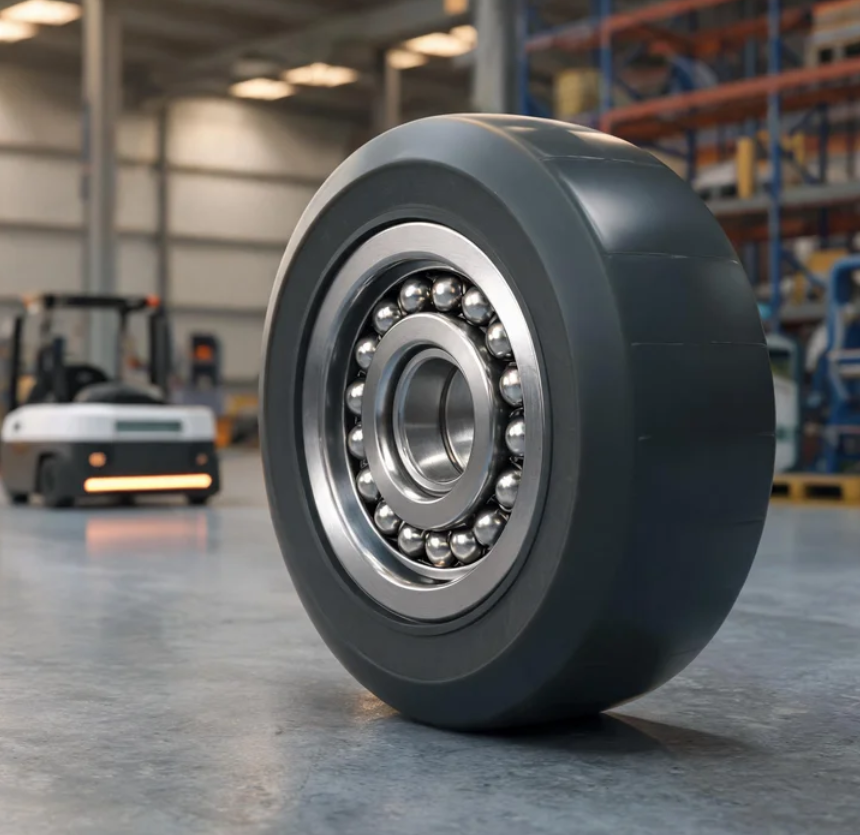
On a polyurethane drive wheel procurement list, the bearing specification is often written as a single model number — for example, "6205-2RS." The purchasing agent places the order, the assembly worker presses it in, and three months later the wheel seizes. The first reaction: "Poor bearing quality."
However, root cause analysis of 276 polyurethane drive wheel complaints reveals that only 11% of failures are due to bearing steel material defects. The top three root causes are:
- Seal grade mismatch with operating conditions: 34%
- Incorrect grease selection: 28%
- Clearance mismatch with temperature rise: 18%
None of these are "bad bearings." They are systematic mismatches at the selection level.
The operating environment of a bearing inside a polyurethane wheel is fundamentally different from bearings in electric motors, pumps, or conveyors. The polyurethane tread contacts the ground directly — impact loads transmit through the tread → hub → bearing, ground wear particles and moisture seep in along the tread edges, and the wheel heats up continuously due to hysteresis heat generation in the polyurethane elastomer. These operating conditions are rarely addressed together in standard bearing selection manuals.
The purpose of this article is not to teach basic bearing identification, but to provide a **bearing selection decision framework specifically for polyurethane drive wheel applications**.
Before discussing selection, it is essential to understand the **three unique stress factors** that polyurethane drive wheel bearings endure. These factors rarely appear simultaneously in general bearing applications but are the norm for polyurethane wheels.
Motor bearings primarily handle steady radial loads, typically fluctuating within 20%. In contrast, a polyurethane drive wheel running on the ground experiences an instantaneous impact every time it crosses a floor joint, speed bump, or metal debris.
HANKE conducted a comparative test in 2024 using the same AGV fitted with identical bearings (6205-2RS/C3), measuring real-time load fluctuations at both the motor end and the wheel end. Results: **the instantaneous impact peak at the wheel end was 4.7 times that of the motor end**. Impact frequency varied with floor smoothness — approximately 1.2 impacts per meter on epoxy flooring and 3.8 impacts per meter on standard concrete.
This means the actual operating condition of a polyurethane wheel bearing is closer to that of a **vibrating screen** than a rotating electric motor.
Polyurethane elastomers generate heat through hysteresis during repeated compression-recovery cycles. Thicker treads, lower hardness, and heavier loads all increase heat generation. HANKE measured wheel core temperatures after 2 hours of continuous full-load operation:
- Saxflex 75A tread: 75–85°C
- Eamflex 93A tread: 55–65°C (lower internal damping)
This temperature difference directly affects grease selection and clearance prediction:
- Standard lithium grease accelerates evaporation loss above 75°C, reducing service life to 1/3 of normal
- A 40°C temperature rise causes approximately 0.012–0.018 mm of inner ring expansion — enough to turn C0 clearance into zero or even negative clearance
The seal of a polyurethane drive wheel bearing must simultaneously resist three types of contaminants: ground dust and grit (abrasive wear), moisture and cleaning chemicals (corrosion), and polyurethane wear powder (highly adhesive). Complicating matters further, most AGV wheels are mounted under the vehicle chassis, and users do not perform regular regreasing or flushing as they would for motor bearings.
Once a seal fails, bearing life is measured in hours, not days.
Bearing Type | Radial Load | Axial Load | Self-Aligning | Speed Limit | PU Wheel Rating |
Deep Groove (e.g. 6205) | ★★★★ | ★★ | No | High | Recommended ★★★★★ |
Angular Contact (e.g. 7205) | ★★★★ | ★★★★ | No | High | Specific use ★★★ |
Self-Aligning (e.g. 1205) | ★★★ | ★ | ★★★★ | Medium | Not recommended ★★ |
Cylindrical Roller (e.g. NU205) | ★★★★★ | None | No | High | Heavy load ★★★ |
Deep groove ball bearings are the most widely used type in polyurethane drive wheels, accounting for approximately 86% of HANKE's 2024 shipments. Their advantages include:
- Strong radial load capacity: Drive wheels primarily bear radial loads (vertical pressure between wheel and ground)
- Compact design: Maximum internal space for seals and grease within the same outer diameter
- Sufficient speed range: AGV/AMR drive wheel speeds typically range from 50–500 rpm, well below the limiting speed of deep groove bearings
- Cost-effective: Standardized models with mature supply chains and low replacement costs
Application scope: AGV drive wheels / driven wheels, conveyor rollers, forklift wheels, floor scrubber wheels, and the majority of polyurethane wheel applications.
Angular contact bearings are the better choice when a polyurethane drive wheel must withstand significant axial forces — such as steering wheels, omni-wheels operating on inclined surfaces, or applications requiring tight axial play control.
However, angular contact bearings require paired mounting (back-to-back or face-to-face), which in polyurethane wheels typically means two angular contact bearings per wheel assembly. This increases axial space requirements and cost. HANKE currently applies angular contact bearings only in heavy-load omni-directional drive wheels and floor scrubber steering wheels.
Application scope: Omni-directional drive wheels and steering wheels (significant axial load). Represents approximately 8% of HANKE's production volume.
The self-aligning feature — automatic compensation for shaft misalignment — sounds ideal for wheel applications. However, self-aligning ball bearings have two critical drawbacks:
1. Very weak axial load capacity: Only about 10–15% of radial load capacity, yet polyurethane wheels generate non-negligible axial forces during steering and ramp operation
2. Internal space occupied by larger balls: Reduces room for seals and grease, resulting in shorter service life compared to deep groove bearings
In HANKE's comparative tests, replacing self-aligning bearings with deep groove bearings in the same wheel configuration improved bearing life by approximately 60%.
Note: Some domestic caster manufacturers use self-aligning ball bearings for cost reasons, but AGV drive wheels should avoid this type entirely.
Application scope: Not recommended for drive wheels.
If bearing type selection is "choosing the right direction," seal grade selection is "what determines how far you get."
Seal Type | Code | Structure | Dust Resist. | Water Resist. | Starting Torque | PU Wheel Application | Typical Life (PU Wheel) |
Double Contact Seal | 2RS / 2RU | Rubber lip contacts inner ring | ★★★★ | ★★★★ | Higher | Most drive/driven wheels | 8,000–12,000 hrs |
Double Non-Contact Shield | ZZ / 2Z | Metal shield, gap to inner ring | ★★★ | ★ | Low | Dry clean environments | 3,000–5,000 hrs |
Open (No Seal) | No suffix | No protection | ☆ | ☆ | Lowest | Not recommended | Hundreds of hrs |
HANKE conducted a 180-day tracking test in 2023 comparing different seal types on polyurethane drive wheels. Test conditions: concrete-floor AGV warehouse, 8 hours daily operation, weekly wet-mop cleaning.
Results:
- 2RS seal group: Bearings remained intact after 180 days, grease showed no visible contamination, starting torque increased by only 15%
- ZZ shield group: Slight noise appeared on day 42; inspection on day 90 revealed dust-contaminated grease (gray discoloration); failed on day 120
- Open group: Seized on day 18
This test confirms that in typical industrial floor environments, double contact seals are not optional — they are mandatory.
Even with the same 2RS designation, seal lip material varies:
Seal Lip Material | Temperature Range | Abrasion Resistance | Application |
NBR (Nitrile Rubber) | -40~120°C | ★★★ | General purpose, cost-effective |
FKM (Fluorocarbon Rubber) | -20~200°C | ★★★★ | High-temperature (Saxflex 75A high heat generation) |
HNBR (Hydrogenated Nitrile) | -40~150°C | ★★★★★ | High wear, high impact |
HANKE's standard configuration for bearings paired with the Eamflex 93A tread compound uses NBR seal lips. For Saxflex 75A high heat generation scenarios (wheel core temperature reaching 85°C), upgrading to FKM lip material is recommended, extending seal life by approximately 1.8 times.
Bearing internal clearance is the total gap between the rolling elements and the raceways. For polyurethane drive wheels, incorrect clearance selection is the third leading cause of premature bearing failure — yet it is also the lowest-cost improvement, as changing clearance grade does not change the bearing's external dimensions.
Clearance Grade | Code | Radial Clearance (6205, pre-install) | PU Wheel Rating | Typical Application |
Normal | C0 (CN) | 5–20 μm | ★★ | Low speed, light load, normal temp |
Reduced | C2 | <10 μm | ★ | High-precision positioning (not for drive wheels) |
Increased | C3 | 20–35 μm | ★★★★★ | Heavy AGV drive wheels, high heat |
Greater | C4 | 30–50 μm | ★★★ | Extreme temperature, extreme impact |
This is the most common selection mistake: assuming "smaller clearance means higher precision" and choosing C0 for polyurethane drive wheels. This logic overlooks two critical factors:
① Thermal expansion consumes clearance
When a bearing heats up inside a wheel, the inner ring expands more than the outer ring (the inner ring temperature is typically 5–10°C higher than the outer ring), reducing radial clearance. Using a 6205 bearing as an example:
- C0 clearance before installation: 10–15 μm
- When wheel core temperature reaches 75°C: clearance reduces by approximately 12–14 μm
- Actual residual clearance: near zero or negative
When residual clearance becomes negative, the rolling elements are clamped between the inner and outer rings. Friction torque rises sharply, generating additional heat that further increases temperature — creating a thermal-force positive feedback loop that ultimately causes the bearing to seize.
② Impact loads require clearance for cushioning
When a polyurethane wheel passes over floor joints and uneven surfaces, the rolling elements need microscopic displacement space within the raceway to absorb impacts. Under C0 clearance, rigid contact transfers impact forces directly to the rolling elements and cage, accelerating fatigue.
HANKE's field test data under identical conditions (heavy-load AGV, industrial epoxy flooring, 10 hours daily operation):
- C3 clearance bearing group: average life 9,200 hours
- C0 clearance bearing group: average life 3,900 hours
C3 clearance extended life by 2.36 times.
(Decision tree text follows below)
- Wheel core steady temp ≤ 55°C AND light load → C0 acceptable, but C3 recommended
- Wheel core steady temp 55–75°C OR medium load → C3 clearance (recommended)
- Wheel core steady temp > 75°C OR heavy load OR frequent impact → C3 (mandatory), evaluate C4
- High precision positioning but light load → C2 (not for drive wheels)
Note: The slight radial runout caused by C3 clearance (approximately 0.01–0.02 mm) does not affect positioning accuracy in most AGV/AMR applications. Only for high-precision AGVs (repeat positioning accuracy ≤ ±1 mm) should downgrading to C0 be considered, and only with adequate heat dissipation or low-heat-generation tread compounds.
Approximately 80% of premature bearing failures are related to poor lubrication. In polyurethane drive wheels — where grease is "filled once for life" — the consequences of incorrect grease selection are especially severe.
Grease Type | Base Oil | Thickener | Temp Range | Water Resist. | Vibration Resist. | Life at 75°C | Recommended Use |
Lithium (General) | Mineral oil | Li soap | -20~120°C | ★★★ | ★★ | 500–800 hrs | Light load, dry env. |
Polyurea (High-temp) | Synthetic oil | Polyurea | -40~200°C | ★★★★ | ★★★★ | 2,000–3,500 hrs | AGV drive wheel |
Complex Li soap | Mineral/synthetic | Complex Li | -30~160°C | ★★★ | ★★★ | 1,200–2,000 hrs | Medium temp alternative |
Silicone | Silicone oil | Silica gel | -50~200°C | ★★★★★ | ★★ | 800–1,500 hrs | Extreme low temp |
Solid lubricant-additive | Synthetic oil | Various | -30~180°C | ★★★ | ★★★★★ | 1,500–2,500 hrs | High impact, vibration |
In accelerated life tests comparing 20 different greases, HANKE found that polyurea grease delivers the best overall performance in polyurethane drive wheel conditions. Three key reasons:
① Longest high-temperature life: At 75°C continuous operation, polyurea grease has 3–4 times the oxidation life of standard lithium grease. This is because the polyurea thickener contains no metal ions that would catalyze base oil oxidation.
② Excellent shear stability: Polyurethane wheels experience continuous vibration during operation (micro-oscillations caused by floor unevenness), which accelerates mechanical shear of the grease. Polyurea's fiber structure recovers relatively quickly after shear, while lithium grease — once mechanically thinned — struggles to recover, leading to leakage and insufficient lubrication.
③ Low volatility reduces replenishment needs: Grease replenishment inside sealed bearings is difficult; lower volatility means a longer effective lubrication period.
In extreme heavy-load or frequent start-stop scenarios — such as automotive welding line transfer stations — the oil film between rolling elements and raceways can be squeezed out during start-stop transitions, leading to boundary lubrication. Grease containing MoS₂ or graphite forms a solid lubricant film on metal surfaces, continuing to lubricate even when the oil film breaks.
HANKE used an MoS₂-containing complex lithium grease in the Mercedes-Benz production line polyurethane drive wheels. The wheels operate on a welding line with over 2,000 start-stop cycles per day and travel distances of only 3–5 meters per cycle. Standard polyurea grease showed boundary lubrication failure after 3 months; after switching to the solid lubricant formulation, bearing life extended from 4 months to 18 months.
With the above selection dimensions understood, the engineering logic behind HANKE's dual-seal bearing design for polyurethane drive wheels becomes clear.
In HANKE's design, "dual seal" refers to a two-layer defense system, not two independent seal rings:
Seal Layer | Structure | Function | Material |
1st (Outer defense) | Labyrinth seal between hub and bushing + O-ring | Blocks large grit and direct water spray | NBR/FKM O-ring |
2nd (Inner defense) | Bearing's built-in 2RS seal | Blocks fine dust, prevents grease leakage | NBR with dust lip |
These two layers form a stepped barrier: large particles are stopped by the first layer, while fine particles and moisture are intercepted by the second. This design reduces grease leakage (grease escaping past the seal) by approximately 67% compared to using a 2RS bearing alone.
HANKE's Eamflex 93A and Saxflex 75A tread compounds have different matching requirements for bearing solutions:
Tread Compound | Hardness | Wheel Core Temp. | Recommended Bearing Solution | Key Consideration |
Eamflex 93A | 93 Shore A | 55–65°C | 6205-2RS/C3 + Polyurea grease | Wear resistance priority, controllable temp |
Saxflex 75A | 75 Shore A | 75–85°C | 6205-2RS(FKM lip)/C3 + High-temp polyurea | Higher heat generation, seal material upgrade |
Eamflex + Steel hub | 93 Shore A | 50–60°C | 6305-2RS/C3 + Polyurea grease | Heavy load, larger bearing size |
This tread-bearing collaborative selection approach optimizes the wheel as a complete system, rather than optimizing the tire and bearing separately.
- Symptoms: Drive wheel bearing noise after 3 months, seizure after 6 months
- Root cause: ZZ shields could not prevent cement dust ingress; lithium grease formed an abrasive slurry when contaminated with dust
- Corrective action: Replaced with 2RS seal + C3 clearance + polyurea grease
- Result: Bearing life extended from 6 months to 26 months (still in service)
- Category: Seal grade selection error (34% of HANKE bearing-related complaints)
- Symptoms: Severe bearing heating during full-load operation; wheel shaft temperature reached 95°C after 3 hours; repeated heating-cooling cycles
- Root cause: C0 clearance became zero clearance after temperature rise; rolling elements were clamped, creating a friction→heat→expansion→more clamping positive feedback
- Corrective action: Replaced with C3 clearance; wheel core temperature dropped to 72°C
- Result: Stable temperature during 8-hour continuous operation; bearing life improved by ~2.3 times
- Category: Clearance selection error (18% of bearing-related complaints)
- Symptoms: Bearings corroded and seized after 3 months exposure to alkaline cleaning agents
- Root cause: Standard 2RS NBR lip seals had insufficient chemical resistance; alkaline cleaner penetrated and corroded bearing steel
- Corrective action: Seal upgraded to FKM lip + bearing steel upgraded to stainless steel (440C)
- Result: Bearing life extended to 15 months
- Category: Combined seal material + bearing steel selection failure (~8% of complaints)
Q1: Do polyurethane drive wheels always need 2RS seals?
In most industrial environments (concrete flooring, epoxy flooring, areas with cleaning operations), yes. ZZ shields may only be sufficient in strictly controlled cleanrooms or dust-free workshops. Given the minimal cost difference (2RS is typically only ¥1–2 more expensive than ZZ), standardizing on 2RS as the default configuration is recommended.
Q2: Will C3 clearance affect AGV positioning accuracy?
The radial runout caused by C3 clearance is 0.01–0.025 mm, far smaller than typical AGV positioning requirements (usually ±5–10 mm). For high-precision AGVs (±1 mm or tighter), encoder feedback and control algorithm compensation handle this without issue.
Q3: Can I replace the bearing grease myself?
Not recommended. The quantity and type of grease filled during manufacturing are calculated specifically. DIY replacement may alter the seal's contact state, causing grease leakage or seal failure. If a special grease is required, specify it at the time of procurement so the supplier can apply it during production.
Q4: How often do PU drive wheel bearings need replacement?
This depends heavily on operating conditions. HANKE's standard warranty is 12 months. In actual service:
- Light-load AGV (<8 hrs/day, smooth floor): typically 2–3 years
- Medium-load AGV (8–16 hrs/day, standard floor): 1.5–2 years
- Heavy-load / harsh environment: 6–12 months
Inspect immediately if noise, increased rotation resistance, or abnormal temperature rise occurs.
Q5: Can I use SKF or NSK bearings for PU wheels?
The precision grade and material quality vary between bearing brands. HANKE commonly recommends SKF, NSK, and FAG as mainstream options. However, even premium brands will fail prematurely if the selection (seal, clearance, grease) does not match the operating conditions. A high-grade international brand bearing + wrong selection = expensive failure.
Q6: Saxflex 75A generates more heat than Eamflex 93A. Does that mean I need a more expensive bearing solution?
Not necessarily. The temperature difference of 15–20°C can be mitigated through two approaches:
① Upgrade at the bearing end — FKM seal instead of NBR, high-temperature polyurea grease instead of standard polyurea
② Add heat dissipation features at the wheel design level — hub cooling fins, ventilation holes
HANKE typically combines both approaches in Saxflex 75A matching solutions, ensuring bearing life without significantly increasing cost.
Q7: What should I pay attention to for PU wheel bearings in -20°C cold storage environments?
Low-temperature environments present two challenges: increased grease resistance raising starting torque, and increased bearing steel brittleness at low temperature.
HANKE's cold storage recommended solution: 6205-2RS/C3 + semi-synthetic lithium grease (better low-temperature performance than polyurea) + bearing steel with confirmed low-temperature impact toughness. Refer to HANKE's "Cold Storage and Cold Chain PU Wheel Selection Guide" for details.
Q8: Should drive wheel and driven wheel bearing selection be different?
Yes. Drive wheels bear driving torque, so the axial force (reaction force from traction) is greater than for driven wheels. Therefore:
- Drive wheels: C3 clearance + polyurea grease (considering higher temperature rise and load)
- Driven wheels: C0 or C3 acceptable, lithium or polyurea grease acceptable (milder operating conditions)
Polyurethane drive wheel bearing selection is not a matter of "pick a model number and install it." From bearing type to seal grade, from clearance selection to grease type, from tread compound synergy to operating condition matching — every dimension affects ultimate service life.
Based on HANKE's extensive experience manufacturing polyurethane wheels and analyzing customer complaint data, three bearing selection principles stand out:
1. Seal priority over precision: In polyurethane wheels, seal grade has a far greater impact on life than bearing precision grade. Selecting 2RS seals provides the most cost-effective life insurance.
2. Choose one clearance grade up: The temperature rise and impact characteristics of polyurethane wheels make C3 more suitable than C0 for drive wheels — no cost increase, double the life.
3. Temperature first, then load, for grease: Wheel core operating temperature is the primary parameter for grease selection. For every 10°C increase, grease life is approximately halved.
The selection logic above has been validated in HANKE's projects including the Mercedes-Benz production line AGVs, Tennant floor scrubbers, and Kinco servo wheel applications. If you are facing polyurethane drive wheel bearing selection challenges, use this article's decision framework and match from the operating conditions — not from inventory.
HANKE is a specialized and innovative enterprise focused on the R&D and manufacturing of polyurethane wheels and polyurethane products. Core product lines include drive wheels (GEFA / GE series with the Eamflex 93A high-wear-resistance compound and Saxflex 75A floor-protection compound), driven wheels, guide wheels, bearing-coated rollers, conveyor rollers / coated rollers, and floor scrubber wheels — .
HANKE's production system is built on a 13-step standardized process covering incoming inspection, rough/finish turning, sandblasting, adhesive application, casting, curing, tread finishing, painting, and inspection. The quality system includes CMM measurement, hardness testing, and AQL-based batch sampling.
Partners in the application reference include Mercedes-Benz, Jaguar Land Rover, Geely, Tongli Elevator, Kinco, and Tennant.
Website: www.hankepu.com | Email: HK@putscn.com

