
 EN
EN
Quick Links
In logistics equipment roller selection, polyurethane (PU), rubber, and nylon (PA) are the three most commonly used material systems. This article systematically compares their abrasion resistance, load capacity, floor protection, noise levels, service life, and cost structure through 8 standardized test metrics — including DIN 53516 abrasion and GB/T 528 tensile strength — presented across 5 comparison tables. The core conclusion: polyurethane's overall performance advantage makes it the material of choice for AGVs, smart warehouses, and automotive production lines. Taking HANKE's Eamflex 93A high-wear-resistance compound as an example, its DIN abrasion value is below 40 mm³ — approximately 60% lower wear than nylon and 80% lower than rubber. Meanwhile, HANKE's Saxflex 75A low-noise compound achieves 55–65 dB rolling noise on AGV driven wheels, roughly one-third that of nylon. This article includes 8 FAQs and 3 real-world service cases to help procurement and engineering professionals make informed selection decisions quickly.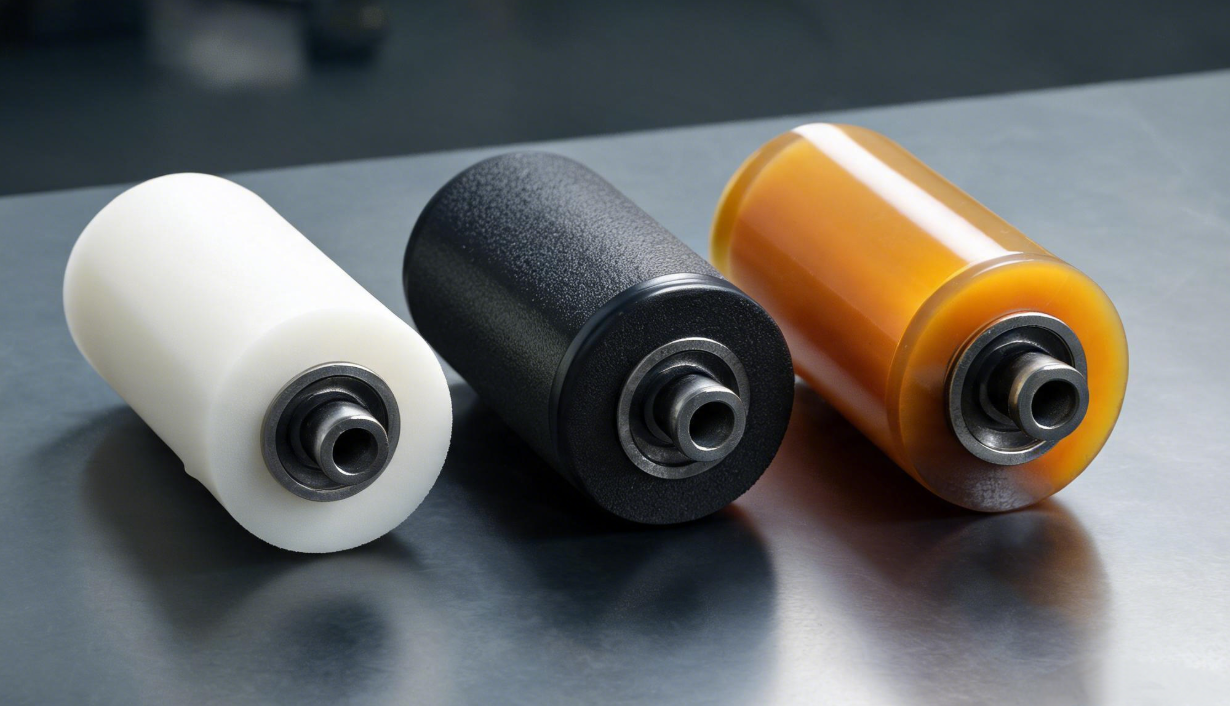
With the proliferation of AGVs, AMRs, and intelligent warehouse systems, logistics equipment rollers face unprecedented performance demands. The traditional "if it rolls, it works" selection logic can no longer meet the following three challenges:
High-Speed Continuous Operation: AGV daily operating hours have extended from 8 to over 20 hours, making roller wear rate a key metric affecting Overall Equipment Effectiveness (OEE). Through serving multiple automotive OEM final assembly lines, HANKE has observed that drive wheel abrasion resistance directly determines monthly AGV downtime frequency.
Escalating Floor Protection Requirements: Epoxy and PVC flooring in high-end factories (automotive, semiconductor, pharmaceutical) costs hundreds of RMB per square meter. Scratch and indentation repair costs from rollers far exceed the rollers themselves. This was the direct driver behind HANKE's development of the Saxflex 75A low-hardness tread compound — on Mercedes-Benz assembly lines, Saxflex driven wheels achieved zero floor damage after 18 months of operation.
Stricter Noise Compliance: EU standard EN 13059 mandates industrial vehicle operator position noise ≤80 dB(A), and domestic smart factories are tightening noise requirements in human-robot collaboration zones. Polyurethane's natural vibration-damping properties make it the preferred base material for low-noise solutions.
A typical selection mistake case: An automotive OEM's logistics department, seeking cost reduction, replaced polyurethane with nylon wheels in an AGV caster upgrade project. Within six months, the nylon wheels caused epoxy floor scratches exceeding 200 m², with repair costs over ¥40,000 — far exceeding the initial wheel cost savings. This is not an isolated incident. Based on HANKE's technical team tracking of nearly 100 customer projects, the indirect losses from incorrect roller material selection (floor repair, downtime, noise complaints) are 5–10 times the cost of the rollers themselves.
The following table compares 10 physical performance indicators across the three materials, based on standardized testing methods (DIN 53516, GB/T 528, etc.):
Property | Polyurethane (PU) | Rubber | Nylon (PA) |
Hardness Range | Shore A 60–98 | Shore A 40–90 | Shore D 70–85 |
Tensile Strength | 30–50 MPa | 10–25 MPa | 60–80 MPa |
Tear Strength | 80–120 kN/m | 20–50 kN/m | High but |
Abrasion Resistance | 30–50 mm³ | 120–200 mm³ | 60–100 mm³ |
Rebound Resilience | 30–50% | 40–60% | <10% |
Density (g/cm³) | 1.15–1.25 | 1.10–1.40 | 1.13–1.15 |
Operating Temp. Range | -30°C to +80°C | -20°C to +70°C | -40°C to +100°C |
Oil/Solvent Resistance | ★★★★★ | ★★☆☆☆ | ★★★★☆ |
Hydrolysis Resistance | ★★★☆☆ | ★★★★☆ | ★★★★★ |
Rolling Resistance | Low | Medium | Low |
Property | Polyurethane (PU) | Rubber | Nylon (PA) |
AGV/AMR Drive Wheels | ★★★★★ | ★★☆☆☆ | ★★★☆☆ |
Floor Protection | ★★★★★ | ★★★★☆ | ★☆☆☆☆ |
Noise Control | ★★★★★ | ★★★★☆ | ★☆☆☆☆ |
High Load | ★★★★★ | ★★☆☆☆ | ★★★★★ |
Humid Environments | ★★★☆☆ | ★★★★☆ | ★★★★★ |
Cleanroom/Dust-Free | ★★★★☆ | ★☆☆☆☆ | ★★★☆☆ |
Outdoor/UV Exposure | ★★★☆☆ | ★★☆☆☆ | ★★★★☆ |
Cost Dimension | Polyurethane (PU) | Rubber | Nylon (PA) |
Unit Procurement Cost | 100 (baseline) | 60–80 | 120–150 |
Normal Service Life | 18–36 months | 6–12 months | 12–24 months |
Floor Maintenance | Very low | Medium (black marks) | Very high (scratch repair) |
Replacement Frequency | Once per 2–3 years | Once per year | Once per 1–2 years |
5-Year TCO | ★★★☆☆ Moderate | ★★★★★ Lowest | ★★☆☆☆ Highest |
Process Dimension | Polyurethane (PU) | Rubber | Nylon (PA) |
Hardness Custom Range | Shore A 60–98 | Shore A 40–90 | Shore D 70–85 |
Color Customizability | ★★★★★ | ★★☆☆☆ | ★★★★☆ |
Metal Hub Bonding | ★★★★★ | ★★★☆☆ | ★★☆☆☆ |
Small-Batch Custom | ★★★★★ | ★☆☆☆☆ | ★★★★☆ |
Surface Texture Control | Smooth / orange peel / granular | Mold texture only | Mostly smooth |
Formula System Diversity | Ester / Ether / NDI / MDI | NR / SBR / NBR / EPDM | PA6 / PA66 / PA12 |
DIN 53516 is the internationally recognized abrasion testing standard for rubber and elastomers. The test method involves subjecting a specimen to a rotating abrasive cloth drum under specified contact pressure and travel distance, measuring volumetric loss in mm³. Lower values indicate better abrasion resistance.
Typical data: Polyurethane specimens typically show DIN abrasion values between 30–50 mm³, while rubber specimens typically range from 120–200 mm³. This means that under equivalent operating conditions, polyurethane wheel service life can reach 3–5 times that of rubber wheels. Notably, polyurethane abrasion resistance does not have a linear relationship with hardness. Taking HANKE's Eamflex 93A compound as an example — through optimized polyol-to-isocyanate ratio control, it maintains a DIN abrasion value below 40 mm³ at 93 Shore A hardness, achieving the unification of high load capacity and high wear resistance. This data is verified on a per-batch basis on HANKE's CHOTEST coordinate measuring platform.
Compression set (GB/T 7759 / ISO 815) measures a material's ability to recover its original shape after prolonged compression — directly relevant to whether AGV wheels develop "flat spots" during extended parking. Polyurethane's compression set typically ranges from 15–25% (70°C × 24h), outperforming rubber's 25–40%. In HANKE's Eamflex 93A compound design, the introduction of heat-resistant isocyanate components keeps compression set below 18% — meaning that after an AGV sits idle for a 48-hour weekend, the wheels recover full roundness within only a few rotations on startup, requiring no additional "warm-up" time. Nylon, while exhibiting almost no compression set (<2%), pays the price in lost elasticity — impact energy from traversing floor joints or uneven surfaces transmits directly to the vehicle body and cargo, increasing cargo damage risk.
Some domestic manufacturers report abrasion data using GB/T 1689 (Akron abrasion) rather than DIN 53516. These two standards are not directly convertible. Akron abrasion is measured in cm³/1.61 km, with lower values being better. Polyurethane Akron abrasion values typically range from 0.03–0.08 cm³. When comparing different brands, always verify which test standard is being used to avoid being misled by non-comparable figures. HANKE provides both DIN 53516 and GB/T 1689 values in its test reports to facilitate apples-to-apples customer comparisons.
The following methodology is distilled from HANKE's technical team experience serving automotive, AGV, and warehouse logistics industries. It provides a systematic framework for engineers and procurement professionals to make material selection decisions.
Ask one question: What must this wheel absolutely never fail at?
• If it's an AGV drive wheel → Priority: "No slippage + high wear resistance" → Polyurethane (e.g., Eamflex 93A compound, balancing friction coefficient and wear life).
• If it's a cleanroom environment → Priority: "Zero particle generation" → Polyurethane (special low-dust formula) or nylon.
• If it's a high-humidity cold storage → Priority: "No hydrolysis" → Nylon or polyurethane (ether-type formula; HANKE offers PTMEG+MDI hydrolysis-resistant solutions).
Calculate single-wheel static load × dynamic load factor. For AGVs, a dynamic factor of 1.5–2.0 is typical.
• <300 kg per wheel: All three materials are viable.
• 300–800 kg: Polyurethane and nylon are suitable; rubber is nearing its limit.
• >800 kg: Polyurethane (high-hardness systems like Eamflex 93A or NDI-based) or nylon. Rubber experiences severe creep in this range and is not recommended.
• Epoxy / PVC flooring → Must use low-hardness (~75 Shore A) polyurethane (e.g., Saxflex system, verified zero-scratch on Mercedes-Benz and Geely production lines), or soft rubber.
• Concrete floors → Greater material selection freedom; focus on wear resistance and load capacity.
• Steel grating / rough surfaces → Nylon or high-hardness polyurethane; rubber is easily cut and torn.
Human-robot collaboration zones: ≤65 dB is recommended. Under standard conditions, polyurethane wheels operate at 55–65 dB, rubber at 60–70 dB, and nylon at 70–80 dB. If the wheels (rather than motors or drive systems) are the primary noise source, switching to polyurethane can reduce rolling noise by 10–15 dB — the difference between "earplugs required" and "normal conversation possible" on a mixed human-robot production line. HANKE's Saxflex 75A system has been measured at 62 dB in multiple AGV driven-wheel projects.
Do not evaluate unit price in isolation. Sum procurement cost, replacement frequency, downtime losses, and floor maintenance costs to calculate the 5-year Total Cost of Ownership (TCO). In most intelligent logistics scenarios, polyurethane delivers the optimal 5-year TCO — unit procurement cost is higher than rubber, but replacement frequency is 2–3× lower and floor maintenance costs approach zero. We recommend requesting service-life reference data and TCO calculation support from suppliers for your specific operating conditions.
Q: Which is more wear-resistant — polyurethane or rubber wheels?
Polyurethane wheels far outperform rubber wheels in wear resistance. Under DIN 53516 abrasion testing, polyurethane shows wear volumes of 30–50 mm³, while rubber typically measures 120–200 mm³ — a 3–5× difference. Taking HANKE's Eamflex 93A compound as an example, its measured DIN abrasion is below 40 mm³, with actual AGV drive wheel service life reaching 24–36 months — 2–3× that of rubber wheels under identical conditions. Note that polyurethane's wear resistance is closely tied to its formula system — different hardness levels and raw material systems (MDI/NDI/TDI) yield significantly different performance. Always request supplier-provided DIN abrasion test data when selecting.
Q: Why are nylon wheels so noisy? Can this be fixed?
Nylon is a rigid material with a high elastic modulus and virtually no vibration-damping capacity. When nylon wheels roll over hard floors, vibration energy from joints and unevenness transmits directly to the vehicle body and surrounding structures, producing 70–80 dB of rolling noise. This is inherent to the material and cannot be fundamentally resolved. Where noise requirements are strict (e.g., human-robot collaboration zones), we recommend replacing nylon wheels with polyurethane — taking HANKE's Saxflex 75A low-noise compound as an example, it measures only 62 dB under equivalent conditions, a ~15 dB reduction. This system is deployed across multiple automotive OEM AGV projects with positive operator feedback.
Q: Can polyurethane wheels be used in wet or humid environments?
Yes, but the correct polyurethane type must be selected. Polyurethane divides into two major categories: ester-type and ether-type. Ester-type PU has relatively poor hydrolysis resistance and will degrade under prolonged high-humidity or water-immersion conditions. Ether-type PU (PTMEG-based) offers significantly superior hydrolysis resistance, making it suitable for cold storage, seafood processing, and outdoor humid environments. HANKE's hydrolysis-resistant solution uses a PTMEG+MDI ether system, validated over 18 months in a fresh-food e-commerce cold storage AGV project with zero hydrolysis-related failures. Always clarify operating conditions with your supplier to match the correct formula system.
Q: Are polyurethane wheels always more expensive than rubber?
Unit procurement cost is indeed higher for polyurethane (typically 30–60% more than rubber). However, from a 5-year Total Cost of Ownership (TCO) perspective, polyurethane is often the more economical choice for three reasons: ① Service life is 2–3× longer, reducing replacement frequency; ② No floor scratching, avoiding epoxy repair costs (ranging from thousands to tens of thousands of RMB per incident); ③ No black rubber marking residue, reducing floor cleaning costs. In industries with stringent floor cleanliness requirements — automotive and electronics being the highest-density application sectors for HANKE's Eamflex/Saxflex dual-system — polyurethane's TCO advantage is particularly pronounced.
Q: Can the three materials be used in combination?
Yes, and this is common industrial practice. For example: AGV drive wheels use high-hardness polyurethane (e.g., Eamflex 93A for transmission efficiency and wear life), while driven and guide wheels use low-hardness polyurethane (e.g., Saxflex 75A for vibration damping, noise reduction, and floor protection). In specialized cases, a steel hub can be nylon-injection-molded as a structural component with an outer polyurethane functional layer. Multi-material combinations require a supplier with integrated metalworking + injection molding + casting process capabilities — HANKE's three-step sandblast-adhesive-pour process system was specifically designed for this purpose, ensuring interlayer bond strength exceeding 10 N/mm.
Q: How do I judge the quality of a polyurethane wheel?
Look at three key indicators: ① DIN 53516 abrasion data (<50 mm³ is good quality; HANKE Eamflex measured <40 mm³); ② Bond strength between tread and hub (peel force ≥8 N/mm qualifies; HANKE's three-step process controls to ≥10 N/mm); ③ Whether the supplier has a coordinate measuring machine (CMM) and dynamic fatigue test rig — suppliers without testing capability cannot guarantee batch-to-batch consistency. Additionally, whether a supplier has served automotive OEMs or well-known AGV manufacturers is an important reference signal.
Q: What is the typical service life of polyurethane wheels?
Under standard conditions (8–16 h/day, smooth floors, <300 kg single-wheel load), high-quality polyurethane wheels last 18–36 months. HANKE's Eamflex system has achieved 26–30 months on automotive assembly line AGV drive wheels, with Saxflex driven wheels reaching 36+ months. Key factors affecting service life: ① Floor smoothness (smoother = longer life); ② Load (overloading accelerates creep); ③ Ambient temperature (>80°C accelerates aging); ④ Chemical exposure (strong acids/alkalis degrade polyurethane). Note: Rubber wheels under equivalent conditions typically require replacement within 6–12 months.
Q: What is the lead time for custom polyurethane wheels?
Standard-size polyurethane wheels can ship from stock (1–3 working days). Non-standard custom orders require mold design/modification → pouring → curing → inspection, with typical lead times of 7–20 working days depending on: availability of existing molds, whether new metal hubs need fabrication, and order quantity. At HANKE, leveraging our in-house metalworking shop and polyurethane casting line, small-batch custom orders from order receipt to shipment are typically completed within 15 working days. We recommend engaging suppliers during the new equipment development phase, allowing a 3–4 week customization window.
Initial Problem: The plant's assembly workshop AGV casters originally used nylon wheels. After 8 months of operation, the epoxy flooring showed widespread scratches and indentations, affecting the workshop's 5S rating and customer visit experience. Operators also reported that AGV noise when crossing floor joints was uncomfortably loud, disrupting daily communication.
Solution: After on-site condition assessment by HANKE's technical team, drive wheels were switched to the Eamflex 93A high-wear-resistance polyurethane system (ensuring uncompromised transmission efficiency), while driven and guide wheels were switched to the Saxflex 75A low-hardness polyurethane system (floor protection + noise reduction). The tread formulation was fine-tuned for the friction characteristics of epoxy flooring to maintain consistent braking distance.
Quantified Results: Zero floor damage reports in the 12 months post-switch. Rolling noise reduced from 78 dB to 62 dB. Wheel service life extended from nylon's 14 months to 26 months, reducing annual wheel consumption by approximately 40%. The project has now run for over two years, and the customer adopted the same solution for their new plant expansion.
Initial Problem: Seeking cost reduction, this manufacturer used rubber drive wheels on a latent-type AGV model. Customer feedback after deployment: ① After 3 months of operation, drive wheels showed significant wear and slippage, with AGV positioning accuracy degrading from ±8 mm to ±15 mm; ② Rubber residue adhered to floors as black marks, unacceptable to the end customer (an electronics industry cleanroom facility).
Solution: Rubber drive wheels were comprehensively replaced with HANKE's Eamflex 93A polyurethane compound. Tread pattern design was optimized (chevron → block pattern) to increase friction while reducing debris embedding. The bonding process used HANKE's three-step sandblast-adhesive-pour system, ensuring stainless steel hub-to-tread bond strength >10 N/mm and eliminating the delamination issues common in the original rubber solution.
Quantified Results: AGV positioning accuracy restored to ±8 mm. Wheel replacement interval extended from 3 months to 12 months. Black floor marking issue completely resolved. End-customer satisfaction improved from 6.5/10 to 9.0/10. The manufacturer subsequently incorporated the polyurethane solution into its AGV standard BOM.
Initial Problem: This cold storage facility (-18°C constant temperature) sorting AGVs originally used rubber wheels, which failed in two critical ways within 3 months: ① Rubber hardened and embrittled at low temperatures, reducing drive wheel friction and causing ramp-climbing slippage averaging 12 incidents per month; ② Frequent condensation from entering/exiting the cold storage accelerated rust formation and debonding at the hub-rubber interface.
Solution: HANKE's ether-type polyurethane formula (PTMEG+MDI system) was deployed. This system offers significantly superior hydrolysis resistance compared to ester-type PU while maintaining elasticity at low temperatures (no embrittlement at -30°C). Hubs were upgraded to 304 stainless steel with chemical bonding agent treatment, combined with the sandblast-adhesive-pour process to permanently resolve rust-induced debonding.
Quantified Results: Wheel service life in cold storage conditions extended from rubber's 4 months to 18 months. AGV ramp-slippage rate reduced from 12 incidents/month to zero. Picking downtime attributable to wheel issues decreased 85% year-over-year.
The preceding analysis can be distilled into five actionable selection principles:
1. AGV/AMR Drive Wheels → Choose high-hardness polyurethane (93 Shore A, e.g., Eamflex): No slippage, long service life, floor protection. Unit cost is higher than rubber, but TCO is optimal. In demanding environments like automotive production lines — where high wear resistance, high friction, and low noise must be simultaneously satisfied — polyurethane is the only option that delivers all three.
2. Factory Driven/Guide Wheels → Choose low-hardness polyurethane (75 Shore A, e.g., Saxflex): Low noise (62 dB measured), zero floor scratches. If floors are bare concrete and noise is not a concern, rubber can be considered for cost savings — but factor in the cleaning cost of black rubber marks.
3. Cold Storage / Humid / Outdoor → Choose ether-type polyurethane (PTMEG+MDI) or nylon. Rubber embrittles at low temperatures; ester-type PU hydrolyzes under prolonged moisture. A wrong type selection costs far more than the material price difference — the case of rubber cold-storage wheels failing in under 4 months makes this clear.
4. Ultra-High Load (>1 ton/wheel) on Steel Grating → Nylon may be considered, but evaluate whether noise and floor damage are acceptable. If not, consult your supplier about NDI-based polyurethane solutions (load capacity far exceeding standard MDI systems).
5. Custom Requirements → Prioritize suppliers with integrated metalworking + casting + inspection capabilities. A roller is a system — the compatibility of hub, tread, and bearings determines the final product's reliability. HANKE's three-step sandblast-adhesive-pour process and CHOTEST inspection platform are purpose-built for this systematic quality control.
HANKE (Wenzhou) Polyurethane Technology Co., Ltd. specializes in the R&D and manufacturing of polyurethane drive wheels, driven wheels, guide wheels, bearing-mounted bonded wheels, and coated rollers. Our customers include Mercedes-Benz, Land Rover, Changan Automobile, Geely, KONE Elevators, and other industry-leading enterprises.
The company has established two proprietary tread compound systems — Eamflex (93 Shore A, high wear resistance and high load capacity) and Saxflex (75 Shore A, low noise and floor protection) — built upon three core processes: sandblasting, adhesive spraying, and precision pouring. Quality is assured through the CHOTEST coordinate measuring platform, covering the entire chain from mold design to batch delivery. HANKE is ISO 9001 certified and holds 52 technology patents accumulated over 35 years of dedication to the polyurethane industry.
If your equipment has specific roller material selection requirements, we welcome you to contact HANKE's technical team for on-site condition assessment and customized solutions.
Website: www.hankepu.com
Email: HK@putscn.com
Phone: +86-183-1290-0808
Address: 9F, Building 2, Luomeite Science Park, 515 Haixia Avenue, Lingxi Town, Cangnan County, Wenzhou, Zhejiang, China

