
 EN
EN
Quick Links
CMM: The Core Pillar of Quality Inspection for Polyurethane-Covered Wheels
Why Every Polyurethane Wheel Manufacturer Committed to Quality Relies on Coordinate Measuring Technology
In modern industrial manufacturing, product quality is the lifeblood of any company's survival and development. For polyurethane wheels — core components widely used in logistics, automation equipment, medical devices, and other fields — the precision and reliability of quality inspection directly impact the end user's experience and the service life of the final product. Within the entire quality inspection system, there is one piece of equipment whose importance is often overlooked by outsiders, yet plays a pivotal role as the Guardian of Quality within HANKE and other professional manufacturers — the Coordinate Measuring Machine (CMM).
This article provides an in-depth analysis of the irreplaceable role of CMM technology in the quality inspection system for polyurethane-covered wheels, and demonstrates how HANKE leverages this cutting-edge equipment to safeguard customer quality.
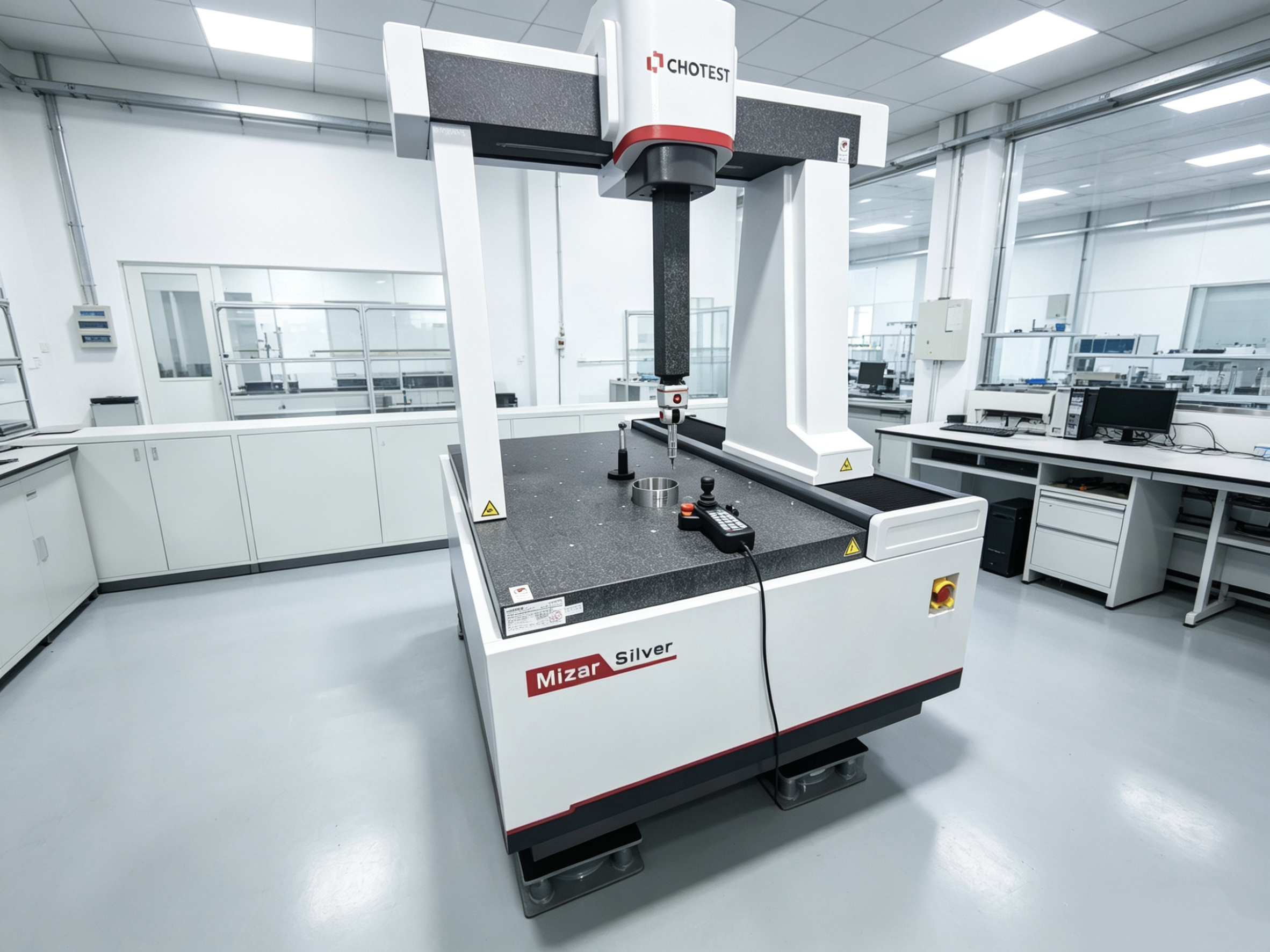
A Coordinate Measuring Machine is a high-precision geometric measurement instrument. Its working principle can be understood as performing a digital scan of a workpiece within three-dimensional space (along the X, Y, and Z axes). The operator places the workpiece to be measured on the CMM's worktable, and the probe system moves along the workpiece surface, recording spatial coordinate values at each probe contact point. The system then precisely calculates various geometric parameters of the workpiece.
Compared to traditional manual measurement tools such as calipers and protractors, CMMs offer the following significant advantages:
|
Measurement Method |
Accuracy |
Efficiency |
Data Traceability |
|
Traditional Manual |
Limited by operator experience |
Time-consuming, difficult for batch inspection |
Dispersed records, hard to integrate |
|
CMM |
Micron-level precision (um) |
Fast batch inspection, automatic data collection |
Fully digital, exportable for analysis |
Simply put, a CMM functions as an industrial CT scanner, capable of seeing every geometric detail of a workpiece with extremely high precision.
Polyurethane wheels are composite structural products, typically consisting of a metal hub (steel core, aluminum core, etc.) as the skeleton, with a polyurethane elastomer wrapped around the outer layer. This structure creates multiple challenges for quality inspection:
One of the core quality indicators for covered wheels is the bonding strength between the polyurethane layer and the metal hub. Poor bonding can lead to polyurethane delamination or peeling during use, posing serious safety hazards to equipment operation. CMM can detect anomalies in the bonding layer through high-precision geometric and tolerance inspection.
Non-uniform polyurethane thickness causes wheel vibration and increased noise during operation, and in severe cases affects the stability of the entire transmission system. A CMM can collect thickness data from hundreds or even thousands of points across the entire covered surface, generating a complete thickness distribution map that intuitively shows the uniformity of the polyurethane layer.
When polyurethane wheels are installed in automation equipment or logistics systems, they have extremely high dimensional accuracy requirements. Excessive deviation in wheel outer diameter affects the precision of conveyor speed, while excessive face runout causes equipment vibration. A CMM can complete inspection of more than ten geometric tolerance items in a single setup, including outer diameter, radial runout, circularity, cylindricity, perpendicularity, and parallelism.
Industrial production emphasizes batch manufacturing and consistency. A CMM can interface with the MES system to enable real-time upload and statistical analysis (SPC - Statistical Process Control) of inspection data, helping manufacturers promptly detect dimensional drift during batch production and eliminate quality issues at the stage.
HANKE deeply understands that the quality of polyurethane wheels is critical to the reliability of customer equipment. Therefore, we have established a high-precision inspection system with the CMM as its core component.
HANKE is equipped with a CHOTEST Coordinate Measuring Machine, a leading precision metrology brand in China. The main technical specifications of this equipment are as follows:
|
Technical Parameter |
Specification |
|
Measurement Accuracy |
Up to 1 um (micron-level), fully meeting precision covered wheel inspection requirements |
|
Measurement Range |
Capable of covering full-size inspection from micro wheels (diameter under 20mm) to large industrial wheels (diameter over 1000mm) |
|
Probe System |
Equipped with high-precision probe for accurate detection of polyurethane soft material surfaces |
|
Software System |
Professional metrology software supporting GD&T analysis, CAD model comparison, and automatic batch statistical report generation |
At HANKE, every polyurethane wheel leaving our facility must undergo the following CMM inspection procedures:
Step 1: Incoming Quality Control (IQC)
Inspect the raw dimensions of metal wheel hubs to ensure skeleton components meet design tolerance requirements, controlling quality at the source.
Step 2: In-Process Quality Control (IPQC)
After the polyurethane molding is completed, inspect key indicators such as polyurethane layer thickness distribution, outer diameter dimensions, and wheel runout to determine whether the product meets process requirements.
Step 3: Outgoing Quality Control (OQC)
Conduct final full-project inspection before packaging and shipment, generating inspection reports containing all geometric tolerance data as ironclad evidence of product quality for customer delivery.
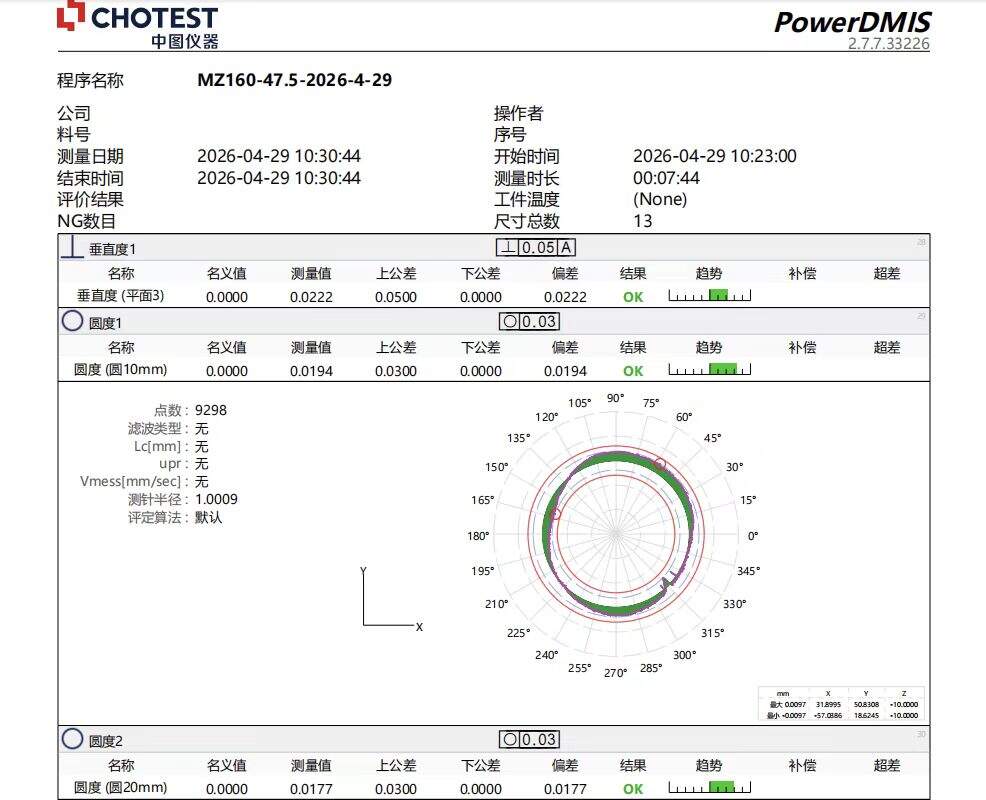
Data Traceability and Quality Archives
Every CMM inspection data is automatically stored in HANKE's quality management system, forming a complete product quality archive. If customers have any quality concerns, HANKE can retrieve the original inspection data for the corresponding batch at any time, achieving true quality traceability.
Dimensional deviation in polyurethane wheels is a common cause of automation equipment vibration, noise, and even premature failure. HANKE's high-precision inspection ensures that every wheel leaving our facility has highly consistent dimensions, significantly reducing customer equipment failure rates and maintenance costs.
HANKE can provide customers with CMM inspection reports as evidence of product qualification, eliminating the need for customers to arrange their own reinspection after receiving goods, greatly shortening equipment verification cycles and accelerating production startup.
When customer equipment experiences abnormalities, HANKE can assist customers in retrieving historical inspection data for comparative analysis, helping locate the source of problems (whether from the wheel itself or from customer-side installation or usage issues). This deep technical support is difficult for ordinary suppliers to provide.
HANKE undertakes a large volume of non-standard custom covered wheel business. Such products lack mature industry standards for reference, and dimensional precision entirely depends on the manufacturer's control capabilities. The CMM inspection system provides HANKE's customized production with a solid technical anchor, making production per drawing and precise fit a reality.
The value of a CMM lies not only in the equipment itself, but also in HANKE's deep understanding and continuous investment in quality control.
HANKE's quality philosophy can be summarized in three levels:
Measurable: Equipping sufficient inspection resources and broad measurement coverage capability
Accurate: Ensuring measurement result authenticity and reliability through equipment calibration, personnel training, and operational standards
Actionable: Transforming inspection data into decision-making basis for quality improvement, rather than merely using it as a Pass/Fail label
The CMM is precisely the core tool that runs through all three levels. It has transformed HANKE's quality control from relying on experience to trusting data, and from post-event inspection to process prevention, truly implementing the modern quality management philosophy that quality is designed in, not inspected out.
Behind the seemingly simple industrial component of polyurethane wheels lies a complete set of precision quality inspection systems, including CMM technology, that supports the quality commitment of every single wheel.
HANKE possesses CHOTEST CMM inspection capabilities, providing every customer with solid and reliable quality assurance through micron-level measurement precision, full-size-range inspection coverage, and digitally traceable quality control systems.
Choosing HANKE means not only selecting a high-quality covered wheel product, but also choosing a quality partnership built on a technological foundation, data-driven decision making, and trust.

