
 EN
Quick Links
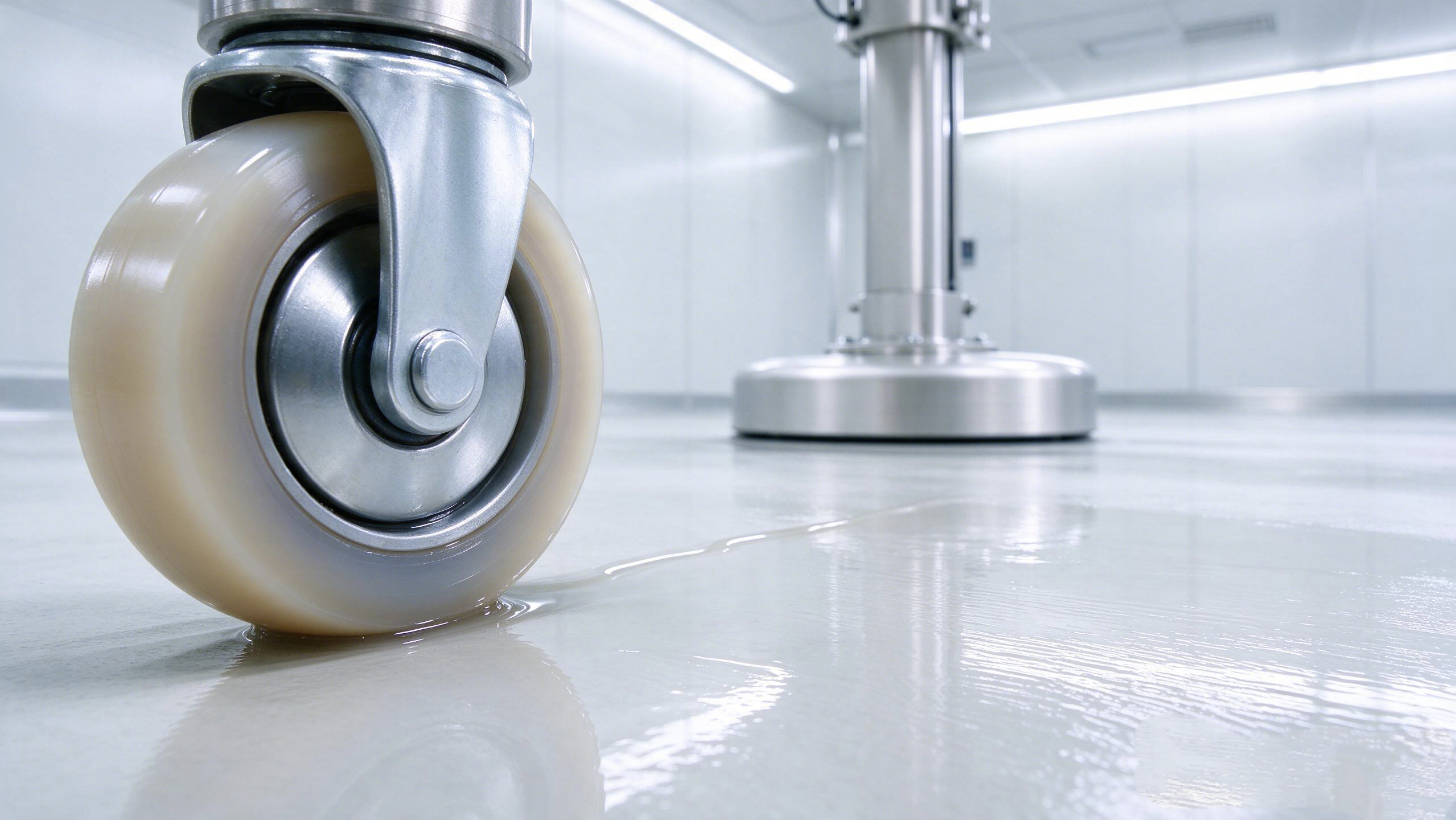 ► In pharmaceutical environments, wear is rarely the leading cause of wheel failure. Hydrolysis, disinfectant attack, and cleaning residue dominate the failure record instead.
► The order of selection is reversed compared with general industrial applications: cleaning and disinfection method comes first, load and speed come later.
► Four of the six requirements in this guide are material issues. Only the last one is the mechanical performance question most buyers ask about first.
► Polyester-based and polyether-based polyurethane behave very differently under continuous wet conditions. Confirming the base system matters more than confirming the material name.
► Different disinfectant chemistries attack polyurethane in different ways. Selection cannot begin without the actual media list from the facility.
Dimension | General industrial workshop | Pharmaceutical production |
Primary failure mode | Abrasive wear, out-of-round | Hydrolysis, disinfectant attack, cleaning residue |
Cleaning frequency | Periodic sweeping | Per shift or daily washing, batch-level in some areas |
Contact media | Dust, oil, grease | Water, ethanol, quaternary ammonium, peroxide disinfectants |
Particle control | No specific requirement | Airborne particle and settle-plate counts by cleanroom grade |
Structural focus | Load capacity and wear life | No cleaning dead corners, no harbourage, no shedding |
Material traceability | Usually not required | Batch-level material and process records |
Note: this table is a qualitative comparison intended to show where the two environments place their emphasis. It does not represent the parameters of any specific project.
In a general industrial workshop, engineers typically start with load. How much weight, how fast, what kind of floor, and only then material and hardness. Wear is the main problem, so wear resistance ranks first.
Apply the same logic to a pharmaceutical workshop and problems tend to surface six to twelve months later, in a batch. The wheels were not worn out. They were degraded by repeated washing and disinfection, or they retained residue in a structural corner and failed a cleaning validation. Neither problem is visible at the purchasing stage, because a new wheel looks and measures correctly.
So in pharmaceutical environments the sequence should be inverted. Ask about the cleaning and disinfection regime first. Ask about the cleanroom grade second. Load and speed come after that. Wear resistance sits considerably lower in this order.
This is not an argument that wear resistance is unimportant. It is an argument that in a pharmaceutical environment, a wheel with the wrong material system or the wrong structure may be pulled from service long before it reaches its wear limit, because it swelled, cracked, shed particles, or failed a cleaning check. Understanding this difference in priority is the first step of selection for this application.
Break down the actual constraints of a pharmaceutical production environment and six requirements emerge. They are not parallel. The first four carry most of the weight, because if they are not met, no amount of strength in the last two will produce a passing validation.
No. | Requirement | What it means in practice | Consequence if not met |
1 | No dust, no shedding | No settleable particles during running; no tread fragments released | Airborne particle counts exceed limits; cleaning validation fails |
2 | Resistant to cleaning and disinfection | Withstands the specified frequency and chemistry of cleaning | Swelling, surface whitening, cracking, hardness drift |
3 | Hydrolysis resistance | Retains properties under moisture and repeated wet-dry cycling | Surface chalking, bond strength loss |
4 | Chemical resistance | Stable against ethanol, quaternary ammonium, peroxide media | Surface degradation, extractables risk |
5 | Cleanable structure | No dead corners, no crevices, no harbourage cavities | Incomplete cleaning; microbial growth risk |
6 | Load capacity and running stability | Holds geometry and roundness at design load and speed | Tracking deviation, noise, docking accuracy loss |
Requirements one through four are material questions. Requirement five is a structural and process question. Only requirement six is the mechanical performance question that datasheets normally address. The difficulty of pharmaceutical selection is precisely that the first three are rarely printed on a product brochure, and have to be confirmed directly with the supplier.
Many people read no shedding as no chunks of rubber falling off. In a pharmaceutical environment the concern operates at a finer scale: micron-scale particles generated by friction during running, and powder released as the material surface degrades with age.
These two sources have different causes and different remedies. Friction-generated particles depend on tread hardness and floor roughness. Age-related chalking depends on hydrolytic stability and antioxidant capability. The first can be improved by adjusting hardness and compound; the second requires a material system decision.
A characteristic of conventional rubber treads is the carbon black and similar filler systems they contain. The black debris produced by wear is conspicuous on light-coloured floors and in classified areas, and is difficult to remove completely. In a general workshop this is a cosmetic issue. In an area subject to cleaning validation it becomes a contamination source that requires explanation.
The advantage of polyurethane is that the compound can be formulated in light or natural colours, so wear products are visually closer to the floor, while its abrasion performance means the absolute rate of material loss is lower. HANKE approaches this through a dual-tread system that separates duties: the HANKE Eamflex 93A system targets high wear resistance and load capacity, while the HANKE Saxflex 75A system targets floor protection and low noise. The two tread types take on different tasks rather than one compound being asked to serve every application.
A note on quantification. Abrasion performance is normally measured against a standard such as DIN 53516, which expresses volume loss under defined conditions. That data supports comparison between materials. It cannot be converted into a service life figure for a specific workshop, because actual life also depends on load distribution, turning frequency, floor condition and the cleaning regime. Treating an abrasion number as a life promise is one of the most common misreadings in selection.
Cleaning and disinfection regimes vary widely between pharmaceutical facilities, and their effect on polyurethane varies just as widely. Arranging the common methods by how aggressively they act on the material shows what needs to be asked during selection.
Cleaning / disinfection method | Active chemistry | Effect on polyurethane | What to check in selection |
Purified water rinse | Water | Long immersion drives hydrolysis, particularly in polyester systems | Whether the compound is a hydrolysis-resistant system |
Ethanol / IPA wipe | Alcohols | Limited effect on short contact; high frequency slowly extracts additives | Additive mobility within the compound |
Quaternary ammonium | Cationic surfactant | Repeated contact may alter surface stress state | Surface treatment and compound compatibility |
Peroxide based (incl. VHP) | Strong oxidiser | Oxidative degradation; surface tackiness or crazing | Antioxidant system and material purity |
Chlorine based | Hypochlorite | Noticeable degradation; usually avoided or contact time limited | Whether a protective structure is required |
Note: the table summarises qualitative material compatibility. Actual severity depends on concentration, temperature, contact duration and frequency. Specific projects should be verified by immersion testing in the actual media.
The most important information in this table is not which disinfectant is harshest on the material. It is that different facilities use different disinfectant combinations, and the actual media list has to be obtained before selection begins. Recommending a material based only on the words pharmaceutical industry is not selection. It is guesswork with a technical vocabulary.
The usual practice is to ask the supplier for immersion test results in the specified media. Coupons are immersed at a defined concentration and temperature for a defined period, then tested for hardness change, volume change, and tensile strength retention. Data of this kind is considerably more useful than a brochure claim of good chemical resistance, and it also reveals whether the supplier has actually run such tests.
Temperature deserves separate attention. The aggressiveness of a disinfectant is not fixed by its chemistry alone. At the same concentration, a warm solution acts more strongly than one at ambient temperature. Some facilities clean at above 60 degrees Celsius, and at that point the compatibility assessment has to be repeated rather than reused.
If there is one technical point that gets overlooked most often in pharmaceutical applications, it is hydrolysis.
Polyurethane divides broadly into polyester-based and polyether-based types according to the soft segment structure. Polyester systems perform better on oil resistance, abrasion resistance and mechanical strength, but in humid conditions the ester bonds hydrolyse. The visible result is surface whitening and chalking, followed by loss of strength, and eventually reduced bond strength at the interface between tread and core. Polyether systems are considerably more stable against hydrolysis, at the cost of some oil resistance and mechanical strength compared with polyester.
In a general industrial workshop the floor is dry, hydrolysis is not the main problem, and polyester systems are widely used for good reasons. In a pharmaceutical workshop washed daily and frequently wetted, ambient humidity stays elevated and hydrolysis moves to the front of the list.
Observation | Abrasive wear | Hydrolysis |
Location | Contact zone, unevenly flattened | Whole surface, including non-contact areas |
Surface appearance | Smooth, with visible wear marks | Whitened, chalky, loss of gloss |
Hardness trend | Broadly stable or slightly rising | May fall then rise, non-uniformly distributed |
Interface condition | Bond line usually intact | Bond strength may decline |
Rate driver | Correlates with running hours | Correlates with time, humidity and temperature, including idle periods |
The last row is the critical distinction. Wear accumulates only while the equipment runs. Hydrolysis continues while the equipment is idle. This means a machine used intermittently but kept in a humid environment may consume its wheels faster than a machine running continuously, which is the opposite of what an hours-based life estimate would predict.
HANKE approaches this from the material system rather than from a surface treatment. The soft segment structure is chosen against the operating environment, and antioxidant and hydrolysis resistance packages are matched at the formulation stage rather than added on top of a base compound. This decision has to be made before tooling and before volume production, because once the specification is fixed, changing the material means revalidating the bonding process and hardness consistency.
Chemical resistance boundaries were listed in the table above. One point is easy to miss: the practical aggressiveness of a disinfectant depends on temperature as well as chemistry, so the assessment has to be made at the temperature actually used, not at room temperature.
Structural dead corners are more subtle. A wheel typically harbours residue in three places:
The edge where tread meets core. If the transition is not designed properly, a narrow crevice forms, cleaning fluid enters and does not drain.
The bearing seat and sealing arrangement. If the seal is not designed for washdown, water enters the bearing cavity.
Recesses and lightening holes on the wheel body. These reduce weight and simultaneously collect water and soil.
None of these three is a material problem. All are structural design and assembly questions. The assessment is direct: take a sample and look at whether the bond line transition is continuous, whether the sealing arrangement was designed for washing, and whether any surface cannot be reached with a single wipe. This requires no test equipment, only that somebody actually looks.
HANKE uses a chemical bonding interface rather than relying on mechanical interlock alone. In ordinary service this shows up as margin in bond strength. In a washdown environment it shows up as resistance to ingress at the interface, because a chemically bonded interface offers no microscopic channel for liquid to travel along.
This requirement is placed last not because it is unimportant, but because in a pharmaceutical environment it rarely becomes the deciding issue if the first three requirements are unmet. Once material and structure are correct, mechanical performance becomes decisive.
Material handling in pharmaceutical facilities is dominated by AGVs, AMRs, cleanroom overhead transport and conveyor lines. The common characteristics are modest loads combined with relatively high positioning requirements, on repetitive fixed paths. This duty profile concentrates the requirement in three areas: roundness and dimensional consistency, hardness stability, and pairing tolerance when wheels are used in sets.
Property | Effect in a pharmaceutical environment | Typical control method |
Roundness and radial runout | Affects running smoothness and repeatable docking | Full-dimensional inspection on a CMM |
Diameter consistency | Affects straight-line tracking and synchronisation in sets | Batch pairing within a controlled diameter band |
Hardness uniformity | Local soft spots accelerate wear and alter contact pressure | Per-piece hardness testing at multiple points |
Static and dynamic balance | Vibration and noise at higher speeds | Balancing to the specified speed requirement |
Bearing clearance and sealing | Affects running resistance and washdown protection | Seal type selected against the duty |
HANKE inspects dimensions on a coordinate measuring machine for full-dimensional verification, and measures hardness at multiple points to confirm distribution rather than relying on a single reading. Sets are paired within a diameter band so that a customer does not see uneven wear on one side after assembly. Finished units are cleaned before packing to reduce particles introduced during transport and handling.
There is no universal answer in material selection. Placing the three common tread materials under the constraints of a pharmaceutical environment makes the applicable range and the boundaries of each much clearer.
Criterion | Polyurethane | Rubber | Engineering plastics (e.g. nylon) |
Abrasion resistance | Good | Moderate | Good |
Debris colour | Light shades possible; absolute loss rate lower | Usually black; debris conspicuous | Light, but worn edges tend to fray |
Hydrolysis resistance | Depends on system; polyether is better | Good | Noticeable dimensional change after water uptake |
Noise and damping | Good | Good | Harder; higher noise |
Load capacity | High | High | Moderate |
Floor protection | Improvable via lower hardness compounds | Poor | Poor |
Cleanability | Dense surface, easy to wipe | Surface tends to retain material | Dense surface, but scratches harbour soil |
Typical fit | Broad suitability | Non-classified heavy-duty areas | Light load, dry, low cleanliness requirement |
The typical fit row is relative. Polyurethane is broadly suitable provided the material system is correct and the structure is sound. A hydrolysis-prone system, or a design that leaves a dead corner, can perform worse in this application than expected. Material ranking on a datasheet is not the same thing as finished-part behaviour in a specific duty.
Two rows in that table deserve expansion. The hydrolysis row is the one most likely to be misread, because a buyer who has used polyurethane successfully in a dry plant will assume the same material will behave the same way here. The soft segment chemistry decides that, and it is rarely visible on a specification sheet. The cleanability row is the one most often attributed to the wrong cause. A wheel that retains soil in a washdown area usually has a geometry problem, not a surface chemistry problem, and it will keep retaining soil after the material is changed.
A practical way to use the comparison is to treat it as an elimination tool rather than a scoring matrix. If the facility washes daily with a peroxide disinfectant, polyester-based polyurethane is eliminated before the comparison begins, regardless of how well it scores on abrasion. Selection narrows quickly once the constraints that cannot be traded are identified first.
The content above can be reduced to a sequence that can be worked through directly. The order cannot be rearranged.
Step | What to confirm | Why it sits here |
Step 1 | Cleaning and disinfection: media, concentration, temperature, frequency | Determines the material system, and is not easily reversible |
Step 2 | Cleanroom grade and particle control requirement | Determines whether extra work is needed on compound and structure |
Step 3 | Load, speed, running hours and floor condition | Determines hardness, dimensions and structural strength |
Step 4 | Equipment constraints: diameter, width, bearing type, mounting | Defines the boundary of feasible options |
Step 5 | Verification requirement: test reports or sample validation | Defines deliverables and lead time |
Step one has to stay first because it decides the material system, and the tooling, process and validation that follow are all built on that decision. Discovering at sample stage that the material does not tolerate the facility disinfectant costs far more than confirming it up front.
Step five is where many projects stall late. If the customer quality team needs an immersion report or a sample trial in the actual media, that work has a lead time of its own and should be scheduled before the order rather than during it.
Pharmaceutical purchasing usually needs documented evidence. The five document types below are arranged by importance, and can be used to judge whether a supplier has genuinely worked in this area.
Document | What it proves | Availability |
Material grade and system statement | Whether the soft segment type is stated, and whether hydrolysis was designed for | Low; should be provided directly |
Immersion test data in the actual media | Behaviour in the customer disinfectants | Medium; must be tested against those media |
Hardness and dimensional records | Batch consistency and inspection method | Low; standard shipping documentation |
Abrasion test data | Basis for comparing wear performance between materials | Low; standard test |
Structure and cleanability description | Bond line transition, sealing type, presence of dead corners | Low; can be judged from a sample |
The first item is the one most often deflected. A supplier who cannot describe the difference between material systems, and answers only that our polyurethane is very good, has almost certainly not made a distinction for wet environments. The check needs no specialist knowledge, only one question: is this polyester-based or polyether-based.
The two address different concerns. Food contact materials focus on constituent migration and safety. Pharmaceutical environments, in addition to the material itself, are concerned with cleaning validation, particle control and traceability. A material that has passed a food contact test has not thereby been shown to satisfy a pharmaceutical cleaning regime.
A harder wheel carries more load with less deflection, but on a smooth epoxy floor the contact area is smaller and stress concentrates locally, which can accelerate wear. A softer tread spreads the contact patch and protects the floor, at the cost of higher rolling resistance. Hardness has to match the floor and the load, not simply go up.
As noted earlier, hydrolysis continues while the equipment is idle. For intermittently used equipment kept in a humid environment, an hours-based estimate will be optimistic. Life assessment in this setting should account for calendar time and environmental exposure alongside running hours.
A change in wheel diameter shifts the motion reference of the equipment. Without recalibration after replacement, even a nominally identical wheel can introduce a positioning offset through diameter tolerance. On higher-precision cleanroom handling equipment this shows up clearly.
When a wheel retains soil, the cause is usually not the material surface but a feature from which cleaning fluid cannot drain. Changing the material does not remove a dead corner; changing the structure does. Look at the structure before discussing the compound.
A boundary needs to be stated here. HANKE does not currently have customer cases it can cite for pharmaceutical production environments. The technical content of this guide is based on polyurethane material behaviour, the general requirements of classified environments, and the process and inspection experience HANKE has built in cleanroom handling and precision drive applications. What follows describes method and capability boundaries, not project references.
The soft segment structure is selected against the operating environment, with hydrolysis resistant systems preferred for wet and frequently washed duty. Antioxidant and hydrolysis resistance packages are matched at the formulation stage rather than layered onto a base compound as an afterthought.
HANKE uses a chemical bonding interface, with the bond surface prepared to form a chemical bond rather than depending on mechanical interlock. Across the 13 process steps, parameters in the surface preparation and casting stages are recorded by batch to preserve consistency within a production lot.
Dimensions are verified on a coordinate measuring machine for full-dimensional inspection. Hardness is measured at multiple points to confirm distribution. Abrasion performance is tested against DIN 53516. Finished units are cleaned before packing to reduce particles introduced during handling.
Where a project requires material safety certification, such as food contact or biocompatibility, or third-party cleanroom validation, that requirement should be confirmed as a separate item at the start of the project and is not covered by default within the standard product range. Stating this early saves considerably more time than explaining it later.
Q1: What is the essential difference between a pharmaceutical wheel and a general industrial wheel?
The difference is not load capacity. It is resistance to cleaning and disinfection media, whether the structure can be cleaned, and particle control. General industrial wheels are not typically engineered for those three points, and when installed in a pharmaceutical area the failures tend to come from them rather than from wear.
Q2: Can polyurethane wheels tolerate alcohol wiping?
Short contact has limited effect. Frequent long-term wiping slowly extracts additives from the compound, which shows up as a change in surface condition. Whether a specific application is acceptable depends on frequency and contact duration, and should be verified by immersion or wipe testing that reflects actual use.
Q3: Why is moisture a problem for polyurethane?
Some polyurethane systems, specifically polyester-based types, hydrolyse in humid conditions. Ester bonds break down, producing surface chalking and loss of strength. Polyether systems are considerably more stable against hydrolysis. The key question in wet environments is therefore which system is used, not simply what the material is called.
Q4: How often should wheels be replaced in a facility that cleans frequently?
There is no universal interval. In a pharmaceutical setting, replacement decisions should consider environmental exposure time alongside running hours, and should be based on hardness change, surface condition and roundness data rather than an hours count alone.
Q5: Is a whitened wheel surface a quality defect?
Not necessarily. Whitening can be an early sign of hydrolysis, but it can also be cleaning agent residue or slight surface exudation. The way to tell is to measure hardness change and tensile strength retention, and to check whether chalking accompanies it. Appearance alone leads to misjudgement.
Q6: Do pharmaceutical wheels require special certification?
Whether certification is needed depends on the specific application and the customer quality system. Projects involving material safety normally require the corresponding test report or declaration. This should be defined at the start of the project and its scope agreed by both parties.
Q7: Can a single worn wheel be replaced on its own?
It is possible in the short term, but equipment using wheels in sets should generally have them replaced in pairs or as a set. A diameter difference redistributes load, so the new wheel carries more and wears faster, and tracking deviation can appear. Reconfirm the equipment calibration state after replacement.
Q8: How can I tell whether a supplier has actually worked in classified environments?
Ask three questions: is the compound polyester-based or polyether-based, can you provide immersion data in the actual disinfectant media, and how is the bond line transition designed against ingress. Suppliers who have done the work answer these directly. Suppliers who have only heard about the application tend not to.
Selecting wheels for a pharmaceutical environment is essentially a reordering of constraints. In general industry, wear resistance moves to the back. Cleaning method and cleanliness requirements, which are rarely asked about at all in ordinary purchasing, move to the front.
Getting the order right is what makes everything downstream meaningful. That judgement does not depend on accumulating experience so much as on asking the right questions: what disinfectants do you use, how often do you wash, what cleanroom grade, does water stand on the floor. The answers to those four questions determine the selection outcome more than any product brochure can.

