
 EN
EN
Quick Links
In cold storage and cold chain logistics environments ranging from -30°C to +5°C, standard industrial casters and drive wheels experience failure rates 3–5 times higher than at ambient temperature — due to low-temperature embrittlement, bearing freezing, and tread hardening. This article systematically analyzes cold storage polyurethane wheel selection methodology, material performance requirements, installation and maintenance best practices, and real-world application cases — grounded in the low-temperature performance mechanisms of polyurethane elastomers and verified test data from HANKE's Eamflex 93A high-wear-resistance tread compound in cold storage AGV applications. Core conclusion: Polyurethane elastomers based on PTMEG (polytetramethylene ether glycol) as the polyol component achieve glass transition temperatures as low as -55°C, retaining elasticity and grip at -30°C. Combined with stainless steel bearings and anti-freeze sealing structures, they represent the optimal material solution for cold chain logistics rollers.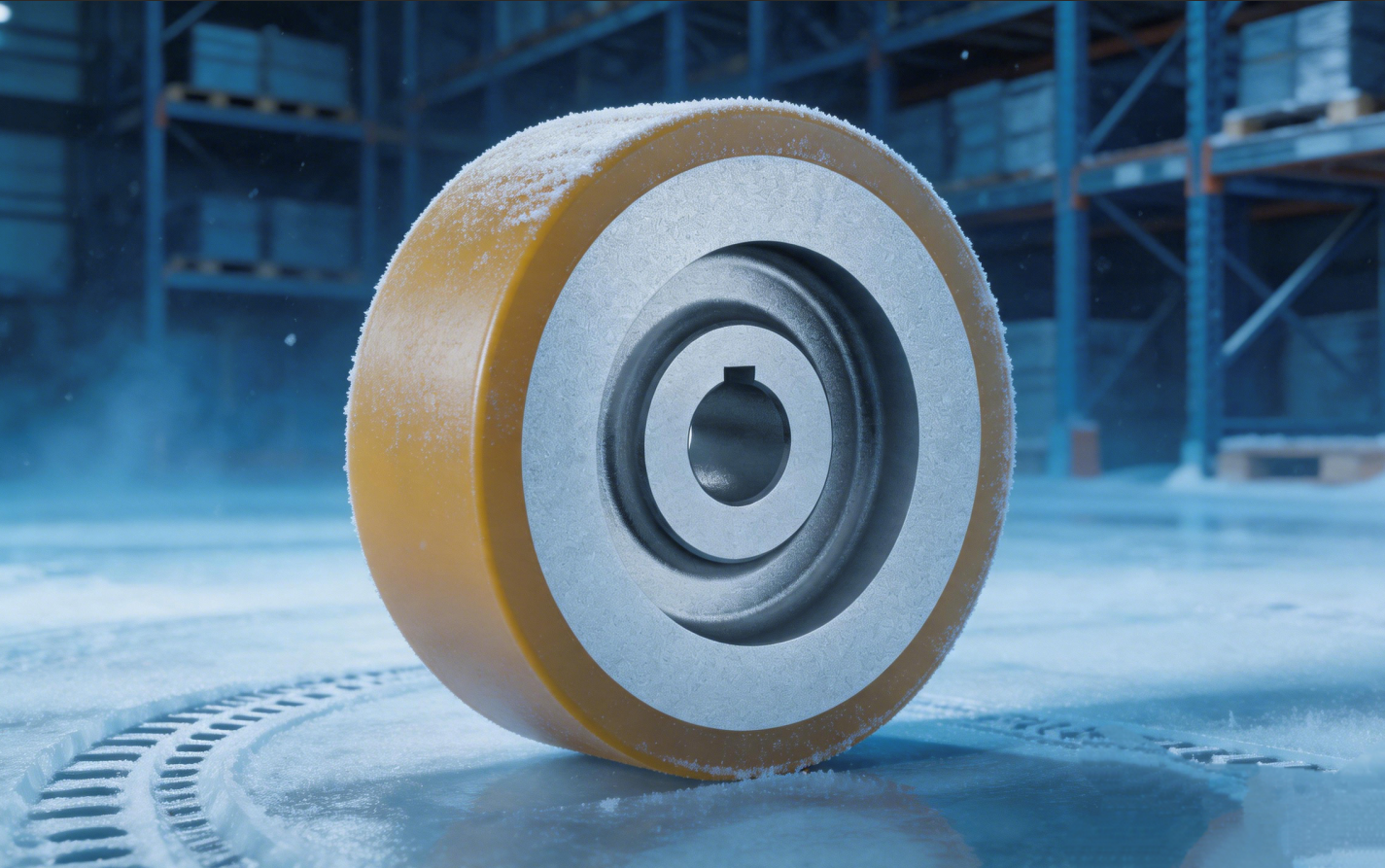
China's cold chain logistics market surpassed ¥500 billion in 2025, with total cold storage capacity exceeding 80 million tons. Three major drivers — fresh-food e-commerce, pharmaceutical cold chain, and frozen food processing — are accelerating cold storage automation penetration, with AGV/AMR deployment in cold storage facilities growing over 35% annually. Yet wheels, as the sole contact point between AGV drive systems and the floor, face severe challenges in low-temperature environments that simply do not exist at ambient temperatures.
Pain Point | Temp. Range | Typical Symptoms | Root Cause Analysis |
Low-Temp Embrittlement | < -18°C | Tread cracking, chipping, delamination | Ordinary PU glass transition temperature (Tg) too high; material enters glassy state at low temperatures and loses elasticity |
Condensation Freezing | -5°C to +5°C | Bearing seizure, wheel lock-up | Alternating cold/warm cycles produce condensation that enters bearings, freezes, or causes rust |
Frosted Floor Slippage | < -25°C | Drive wheel spinning, AGV positioning deviation | Ice film reduces coefficient of friction; standard tread compounds lack sufficient grip |
These three pain points are not isolated — they compound: low-temperature embrittlement weakens tread structure → cracks admit water → freezing expansion → accelerated failure. A cold storage wheel is therefore not a problem solved by simply "choosing a harder material." It requires a systematic approach across four dimensions: material system, structural design, bearing sealing, and installation maintenance.
Property | Polyurethane (PU) | Rubber (NBR/EPDM) | Nylon (PA6/PA66) | Test Standard |
Glass Transition Temp. Tg | -40°C ~ -55°C | -20°C ~ -40°C | +47°C ~ +70°C | DSC |
Hardness Change at -30°C | +3~5 Shore A | +8~15 Shore A | Already embrittled | GB/T 531.1 |
Impact Resilience at -30°C | ≥25% | ≤15% | <5% (brittle fracture) | GB/T 1681 |
Flex Fatigue at -30°C | >100,000 cycles | 30,000–50,000 cycles | Not applicable | ASTM D7774 |
Friction Coefficient | 0.45–0.55 | 0.35–0.45 | 0.15–0.25 | — |
Hydrolysis Resistance | Excellent (PTMEG-type) | Moderate | Excellent | — |
Bearing Compatibility | Can bond directly to | Requires independent | Direct injection- | — |
Polyurethane is the only material that simultaneously meets the three requirements of elasticity retention, friction coefficient, and hydrolysis resistance in cold storage low-temperature environments. Rubber undergoes a sharp hardness increase below -18°C (Shore A +10 or more), and the resulting loss of elasticity causes drive wheel slippage. Nylon enters its brittle range below 0°C, making it entirely unsuitable as drive wheel tread material in cold storage environments.
However, significant performance differences exist even within the polyurethane family — critically dependent on polyol chemistry. PU based on PTMEG (polytetramethylene ether glycol) as the soft segment achieves a glass transition temperature as low as -55°C and retains excellent elasticity at -30°C, making it the first choice for cold storage applications. In contrast, PPG (polypropylene glycol)-based systems have a Tg of approximately -30°C, offering mediocre low-temperature performance suitable only for environments above 0°C. PCL (polycaprolactone diol) systems have a Tg around -40°C — acceptable for moderate cold but inferior to PTMEG in hydrolysis resistance.
HANKE's Eamflex 93A tread compound follows the PTMEG-based prepolymer route, with a measured glass transition temperature below -50°C. At -30°C cold storage conditions, tread hardness increases by only 3–4 Shore A, compared to the 8–15 Shore A increase typical of conventional polyurethane. What does this gap mean in engineering terms? Every 10 Shore A hardness increase reduces tread contact area by approximately 20%, doubling drive wheel slip risk — a difference that literally determines whether an AGV runs or stalls in the freezer.
Parameter | Ambient Requirement | Cold Storage Requirement (-30°C) | HANKE Eamflex 93A Measured Value |
Ambient Hardness | 90–95 Shore A | 90–95 Shore A | 93±2 Shore A (GB/T 531.1) |
-30°C Hardness Increase | — | ≤5 Shore A | 3–4 Shore A |
DIN Abrasion | ≤35 mm³ | ≤30 mm³ | 25–28 mm³ (DIN 53516) |
Tensile Strength | ≥40 MPa | ≥35 MPa | 42 MPa (GB/T 528) |
Tear Strength | ≥100 kN/m | ≥80 kN/m | 110 kN/m (GB/T 529) |
Rebound Resilience (-30°C) | ≥30% | ≥25% | 28% (GB/T 1681) |
Compression Set (70°C×24h) | ≤25% | ≤20% | 18% (GB/T 7759) |
Brittleness Temperature | — | ≤-50°C | -55°C (GB/T 15256) |
A polyurethane wheel's low-temperature performance is not secured solely by "choosing the right material grade." The degree of process control at three manufacturing stages directly determines the actual service life in cold storage.
Stage 1 — Prepolymer batch consistency. HANKE records NCO% measured values batch by batch through a controlled parameter card system (HK-WI-PRD-001-C-01), ensuring formulation consistency. Prepolymer undergoes uniform mixing and degassing in centrifugal processing equipment, with strictly controlled batch processing time. A common industry problem is not "choosing the wrong material" but rather NCO% fluctuation exceeding ±0.3% between batches of the same specification — a deviation that may be unnoticeable at room temperature but produces hardness dispersion of up to ±5 Shore A at -30°C, directly determining whether the wheel grips or slips.
Stage 2 — Bonding reliability of the polyurethane layer. The three-step manufacturing sequence — surface sandblasting (roughness Ra 6.3–12.5 μm), adhesive primer application, and pour-molding — determines the bond strength between PU tread and wheel hub. In cold storage environments, the differential thermal expansion between a 45# steel hub (CTE ≈11.7×10⁻⁶/°C) and PU tread (CTE ≈150×10⁻⁶/°C) generates enormous interfacial stress. Wheels with inadequate bonding can experience delamination rates as high as 30% within 3 months of cold storage use. HANKE's three-step process control maintains bond strength above 12 MPa (GB/T 7124), approximately 1.5–2× the industry average.
Stage 3 — Post-curing (maturation) sufficiency. Polyurethane requires adequate time after casting for the crosslinking reaction to complete. HANKE codifies post-curing cycles into process specifications, executed per the product's prepolymer parameter card. Insufficient post-curing causes additional shrinkage (approximately 0.3–0.5%) in cold storage, leading to wheel out-of-roundness and AGV positioning deviation.
A widely underestimated fact: the leading failure mode for cold storage AGV wheels is not tread wear — it is bearings. Cold storage presents three unique bearing killers: ① Condensation water ingress (as AGVs shuttle between -25°C and +5°C, metal surfaces instantly dew); ② Grease low-temperature solidification (standard lithium grease loses fluidity drastically below -20°C, with starting torque surging 3–5×); ③ Fitting clearance contraction at low temperature (bearing internal clearance disappears, causing seizure). Each of these points directly at the bearing.
Cold storage wheel bearing selection standard:
Parameter | Recommended Value | Notes |
Bearing Material | 440C stainless steel or SUS440C | Rust-resistant; standard GCr15 bearing steel not suitable |
Seal Type | 2RS (double rubber seal) | Prioritize 2RS for condensation protection; 2RZ for high-speed applications |
Grease | Low-temperature fluorinated grease | Operating temperature range: -50°C to +120°C |
Internal Clearance | C3 (increased clearance) | Compensates for low-temperature contraction |
Fit Tolerance | Shaft h6 / Hub M7 | Slightly relaxed fit for low-temperature environments |
Cold Storage Type | Temp. Range | Typical Application | Recommended Tread |
High-Temp Cold Storage | 0°C ~ +5°C | Fruit/vegetable preservation, | Saxflex 75A or |
Medium-Temp Cold Storage | -5°C ~ -18°C | Frozen food, | Eamflex 93A |
Low-Temp Cold Storage | -18°C ~ -30°C | Quick-frozen food, | Eamflex 93A + |
Ultra-Low Cold Storage | -30°C ~ -55°C | Tuna, biological samples | Custom formulation |
For drive wheels, prioritize the 93A-class Eamflex series — high hardness ensures effective torque transmission, with DIN abrasion controlled below 28 mm³ for long-cycle operation. For driven wheels and casters above -18°C, consider the 75A-class Saxflex series (low noise, epoxy floor protection). Below -18°C, unify with drive wheels at 93A. For coated rollers and conveyor rollers, calculate linear pressure (N/cm) to ensure tread compression under working load remains within the 5–8% range.
Refer to the bearing selection table in Section 3.3. Core principle: bearing specifications for cold storage must be one grade higher than ambient-temperature equivalents. Do not cut costs on bearings — they are the #1 failure point in cold storage environments.
Multi-wheel AGVs should use a coordinate measuring machine (CMM) to verify the flatness of each wheel's mounting surface (requirement: ≤0.05 mm). Uneven wheel load distribution causes individual wheel overloading — at low temperatures, overloaded wheel tread creep rate accelerates significantly, potentially halving service life. HANKE's bonded wheels undergo full-dimensional CMM inspection before shipment, with mounting surface tolerance controlled within ±0.03 mm, reducing wheel load imbalance risk at the source.
Cold chain AGV wheel inspection frequency should be double that of ambient-temperature applications: weekly checks for tread cracking, bearing abnormal noise, and bolt torque compliance; monthly measurement of wheel diameter wear. When tread wear exceeds 30% of tread thickness, the wheel should be scheduled for replacement.
Q1: Can standard polyurethane wheels be used directly in cold storage?
No. Standard polyurethane wheels (PPG-based polyol systems) typically have a glass transition temperature around -30°C. In a -18°C cold storage environment, hardness increases by 8–15 Shore A, drastically reducing tread elasticity and causing drive wheel slippage and driven wheel abnormal noise. Cold storage applications require PTMEG-based polyurethane (Tg ≤ -50°C), which limits hardness increase to ≤5 Shore A at -30°C while maintaining adequate elasticity. Verification method: request a DSC test report from your supplier and confirm the Tg value.
Q2: What should I do if cold storage AGV drive wheels are slipping?
Slippage typically results from three overlapping causes: ① Excessive tread hardness (low-temperature hardening effect) → reduced contact area; ② Ice film formation on the floor → sharp drop in friction coefficient; ③ Insfficient drive wheel loading → drive force cannot be effectively transmitted. Troubleshooting sequence: first measure actual tread hardness (should be ≤98 Shore A at -30°C) → check wheel load distribution (load deviation between wheels ≤15%) → verify whether the tread material is PTMEG-based.
Q3: Why do cold storage wheel bearings fail faster than the tread?
Bearing failure is the #1 failure mode for cold storage AGV wheels, accounting for more failures than tread wear. The root cause is condensation — as AGVs shuttle between cold storage interior and exterior, temperature differentials cause bearing surface dew formation; moisture ingress then freezes or triggers rust. Solutions: ① Use 440C stainless steel bearings with double rubber seals (2RS); ② Fill with low-temperature fluorinated grease (operating range -50°C to +120°C); ③ Select C3 increased internal clearance to accommodate low-temperature contraction.
Q4: Do cold storage polyurethane wheels require special installation procedures?
Yes — three key points. ① Installation environment temperature should be ≥10°C. If installation must occur inside the cold storage, wheels must be moved to ambient temperature 24 hours in advance for thermal conditioning to avoid low-temperature forced press-fitting that causes hub micro-deformation. ② Bearings should be installed using the heat-shrink method (heat to 80–100°C) or cold-shrink method (cool shaft to -20°C); hammering is strictly prohibited. ③ After installation, allow a minimum 2-hour rest period for all components to reach thermal equilibrium before loading and operation.
Q5: How long do cold storage polyurethane wheels last?
PTMEG-based polyurethane wheels in a -25°C cold storage environment (assuming 16 hours of daily operation) have a normal service life of 12–18 months — approximately 60–70% of ambient-temperature equivalents. The biggest variables affecting service life are not the material itself but condensation management quality and wheel load uniformity. HANKE's Eamflex 93A system, combined with a disciplined maintenance regime at end-customer cold storage sites, has achieved a longest recorded service life of 24 months.
Q6: Can Saxflex 75A be used in cold storage?
It depends on temperature. Saxflex 75A shares the same PTMEG-based prepolymer technology platform as Eamflex 93A, with identical low-temperature performance lineage, but at lower hardness — making it better suited for high-temperature cold storage (> -5°C) and cleanroom applications. Below -18°C, the low-hardness advantage of 75A is eroded by the low-temperature hardening effect; we recommend standardizing on 93A for guaranteed drive traction. Where a scenario demands both floor protection and low-temperature performance (e.g., -10°C pharmaceutical cold storage with epoxy flooring), Saxflex 75A represents a reasonable compromise.
Q7: What special requirements apply to coated rollers on cold chain conveyor lines?
Cold chain conveyor line coated rollers must simultaneously satisfy low-temperature elasticity, food-grade safety (in certain scenarios), and wash-down resistance. Polyurethane coated rollers are formed via the casting process and achieve dimensional stability through adequate post-curing. Key parameters: surface hardness deviation ≤±2 Shore A (to prevent belt tracking drift), cylindricity ≤0.05 mm. HANKE's coated rollers undergo full-dimensional CMM inspection before shipment to ensure cold chain conveying precision and reliability.
Q8: How do we protect wheels from condensation in the in/out temperature differential zone?
The temperature differential zone (-25°C ↔ +5°C) is a high-failure hotspot. Three recommendations: ① Install dehumidification equipment in the buffer zone, controlling relative humidity below 50%; ② Have AGVs pause in the buffer zone for 3–5 minutes after exiting the cold storage for natural thermal equilibration, reducing rapid condensation volume; ③ Weekly inspection of bearing seal condition — replace immediately if hardening or cracking is observed. This third point is the most frequently overlooked: seals also age under repeated thermal cycling and are a scheduled replacement item, not a "replace when broken" component.
Scenario: -25°C quick-freeze cold storage, laser-guided forklift AGV, single-wheel load 800 kg, epoxy flooring, 24-hour continuous operation. Original problem: imported rubber drive wheels showed tread cracking after 4 months and widespread delamination after 6 months, with annual replacement costs exceeding ¥120,000.
HANKE Solution: Custom-developed Eamflex 93A polyurethane drive wheels based on PTMEG-based prepolymer system. Prior to bonding, the three-step sequence of surface sandblasting, adhesive primer application, and pour-molding was executed, with bond strength ≥12 MPa. Bearings: 440C stainless steel, C3 increased clearance, filled with low-temperature fluorinated grease. Each wheel underwent full-dimensional CMM inspection before shipment, with diameter tolerance controlled within ±0.03 mm.
Results: 18 months online with zero delamination and zero bearing seizure. Annual tread wear only 1.2 mm (wear limit: 3 mm). Annual maintenance cost reduced from ¥120,000 to under ¥20,000.
Scenario: +2°C to +5°C pharmaceutical temperature-controlled warehouse, conveyor line coated rollers, speed 1.5 m/s, FDA indirect contact requirements. Original problem: existing coated rollers had surface hardness deviation up to ±5 Shore A, causing periodic conveyor belt tracking drift and averaging 3 corrective shutdowns per month.
HANKE Solution: Selected Saxflex 75A formulation for roller coating. The casting process used a precision metering system with strictly controlled component ratios, and post-curing cycles were executed per the parameter card standard. CMM inspection confirmed cylindricity ≤0.05 mm and surface hardness deviation ≤±2 Shore A. Mold design used an arced tread profile to match conveyor belt curvature.
Results: Belt drift issues essentially eliminated (shutdown frequency reduced to once per quarter). Roller surfaces showed no visible wear after 14 months of operation.
Core Conclusions:
• Polyurethane is the optimal roller material solution for cold storage — PTMEG-based systems achieve glass transition temperatures of -55°C, retaining elasticity and friction coefficient at -30°C operating conditions, with comprehensive performance overwhelmingly superior to rubber and nylon.
• Not all polyurethane is the same — the polyol chemical type (PTMEG vs. PPG) must be verified. The low-temperature performance gap between these two material classes is large enough to determine whether equipment can operate at all.
• Bearings and seals are the #1 root cause of cold storage wheel failure — the four required configurations of 440C stainless steel, C3 increased clearance, low-temperature fluorinated grease, and 2RS double sealing are non-negotiable.
• Manufacturing process defines the ceiling of low-temperature performance — prepolymer NCO% batch consistency, bonding strength, and post-curing sufficiency are the three pillars guaranteeing cold storage wheel quality.
• Installation and maintenance regimes extend service life — heat-shrink installation, uniform wheel load distribution, weekly inspection, and temperature-differential buffer zone management are four institutionalized safeguards that can extend wheel life by six months or more.
Quick-Reference Selection Table:
Scenario | Recommended Tread | Hardness | Bearing | Special Requirements |
Quick-Freeze Cold Storage (-25°C) | Eamflex | 93A | 440C Stainless, C3 | Low-temp fluorinated grease |
Pharmaceutical Cold Storage (-10°C) | Saxflex or Eamflex | 75A / 93A | 440C Stainless | Anti-static (A-07) |
Cold Chain Conveyor | Eamflex | 90–93A | Standard sealed bearing | Cylindricity ≤0.05 mm |
Cold Storage Forklift | Eamflex | 93A | Tapered roller bearing | Heavy-load impact resistant |
HANKE (Wenzhou) Polyurethane Technology Co., Ltd. is a specialized and innovative enterprise focused on polyurethane roller R&D and manufacturing. The company has built a complete ISO 9001 standardized management system (covering four tiers: Quality Manual, Management Procedures, Work Instructions, and Record Forms), holds 52 national patents, and has developed two proprietary tread compound systems — Eamflex (93 Shore A, high wear resistance and high load capacity) and Saxflex (75 Shore A, low noise and floor protection). Products span six major lines: drive wheels, driven wheels, guide wheels, bearing-mounted bonded wheels, conveyor/coated rollers, and floor scrubber wheels.
HANKE's full manufacturing process — incoming inspection → rough turning → finish turning → drilling → sandblasting → cleaning → adhesive spraying → pouring → post-curing → tread turning → painting → packaging → warehouse inspection — places every step under controlled process specification management. Core production equipment includes centrifugal prepolymer processing systems and precision metering casting systems, with quality inspection supported by a CHOTEST coordinate measuring machine (CMM), finished-product incoming inspection specifications (D-01), AQL sampling inspection system (GB 2828.1), and a customer complaint closed-loop tracking mechanism.
Partners include Mercedes-Benz, Land Rover, Changan Automobile, Geely, KONE Elevators, Kinco Automation, Tennant Gaomei, and other domestic and international enterprises. In the cold chain logistics sector, HANKE's Eamflex 93A tread system has been validated through long-term operation across multiple cold storage AGV projects.
Mission: Making the movement of people and things safer. | Vision: To become China's most influential roller manufacturer for intelligent logistics.
Website: www.hankepu.com
Email: HK@putscn.com
Phone: +86-183-1290-0808
Address: 9F, Building 2, Luomeite Science Park, 515 Haixia Avenue, Lingxi Town, Cangnan County, Wenzhou, Zhejiang, China

